
How to Check for a Warrant in Oscoda County
No public website lists active warrants for Oscoda County. The Oscoda County Sheriff's Office and the local courts do not post a searchable warrant roster. That means a name-based online lookup is not the starting point here. Confirming an Oscoda County warrant takes a phone call to the office that holds it.
The most reliable first step is the Sheriff's Office non-emergency line at 989-826-3214. Deputies can confirm whether an active arrest warrant is on file. If the concern is a missed court date or a probation issue, the court that opened the case is the right contact. The 81st District Court handles most misdemeanor and traffic matters at 989-826-1105. Felony and higher civil cases run through the 23rd Circuit Court and Central Filing at 989-826-1111.
Case and hearing details can add context even without a warrant list. The state MiCOURT Case Search shows public case records by name across many Michigan courts. The 23rd Circuit Court Display lists upcoming hearings and party names for the day. Neither tool is a warrant database, but a live case or a scheduled hearing can point to why a warrant exists. Several official channels work together for a warrant question:
- Sheriff's Office phone - Non-emergency 989-826-3214 for arrest warrant and custody status.
- Issuing court - District Court 989-826-1105 or Circuit Central Filing 989-826-1111 for bench warrants.
- MiCOURT and Court Display - Case history and hearing context, not a warrant list.
- Sheriff public records request - A written FOIA letter for law-enforcement records the phone lines will not release.
- Defense counsel - A lawyer or the regional defender office before any court appearance if arrest is possible.
Sheriff records fall under the Michigan Freedom of Information Act. A written request under MCL 15.231 et seq asks the Sheriff's FOIA coordinator for specific law-enforcement records. Court files follow court rules instead, and the court records request system runs through NextRequest.
Note: Michigan courts are excluded from the Freedom of Information Act, so a warrant tied to a court file is confirmed through the court, not a FOIA letter.
Types of Warrants in Oscoda County
Not every warrant works the same way. The court or judge that signs the order sets its purpose, and that purpose shapes how a person clears it. An arrest warrant and a bench warrant are the two most common kinds, but several others come up in Oscoda County cases. Knowing the type helps a person choose the right office to call.
- Arrest warrant
- A court order that lets police arrest a person based on a criminal complaint or probable cause.
- Bench warrant
- Issued by a judge for a missed court date, contempt, or a failure to follow a court order.
- Search warrant
- Authorizes a search of a place, person, or property, and is often sealed before it is carried out.
- Probation violation warrant
- Issued when a person allegedly breaks the terms of probation.
- Fugitive warrant or hold
- Involves authority from another county or another state.
- Civil body attachment
- Can arise in support or contempt matters, depending on the case type.
Why ICHAT and Online Tools Skip Warrants
The Sheriff's page links to the Michigan State Police criminal history system, and people often assume it answers the question "do I have a warrant?" It does not. The Internet Criminal History Access Tool, ICHAT, is a paid public search of criminal history records. State Police say plainly that warrant information and suppressed records are not available through ICHAT.
ICHAT leaves out more than warrants. It excludes federal records, tribal records, traffic records, juvenile records, local misdemeanors, and criminal history from other states. A clean ICHAT result does not mean a person has no warrant. No public statewide warrant search for Michigan was found either, so the local phone call remains the honest path.
The custody notification service VINE is sometimes confused with a warrant tool as well. VINE tracks whether a person is already in custody and sends alerts about custody changes. It does not search for open warrants. For a person who has not been arrested, VINE returns nothing useful about warrant status, which is why the Sheriff's non-emergency line stays the first call.
Important: A clear ICHAT report is not proof that no warrant exists. Warrants are excluded from ICHAT, so confirm status with the Sheriff or the issuing court.
What an Oscoda County Warrant Record Shows
People expect a warrant record to list a name, a charge, a bond amount, and a court date in one place. Because Oscoda County publishes no official warrant list, most of those fields cannot be pulled from a single public source. Some details surface in a court file if the case is public. Others must be confirmed directly with the court or the Sheriff.
The table below reflects each common field honestly. It marks what a person can reasonably find and what is simply not available from any official Oscoda County warrant list.
| Field | Availability |
|---|---|
| Name | Not available from an official Oscoda warrant list. |
| Warrant number | Not available from an official Oscoda warrant list. |
| Case number | May appear in MiCOURT or the court file if the case is public. |
| Charge | May appear in the criminal complaint or case file if public. |
| Issuing court | Determined from the district, circuit, probate, or family case. |
| Bond | Must be confirmed with the court or the Sheriff. |
| Court date | The Circuit Court Display may show current hearings; call the Oscoda County court to verify. |
| Status or clearance | Must be confirmed with the issuing court or the Sheriff. |
Note: Any third-party website that claims to show a live Oscoda County warrant list is not an official source and should be treated with caution.
How to Resolve an Outstanding Oscoda County Warrant
An unresolved Oscoda County warrant does not go away on its own. It can lead to an arrest during a traffic stop or a routine contact with police. Taking action early gives a person more control over how and when the matter is handled. The steps below follow the official channels in order.
- Do not rely on a third-party warrant website. Start with the issuing court or the Sheriff's Office.
- For a missed court date in district or circuit court, call the court on the case. District Court is 989-826-1105. Circuit Central Filing is 989-826-1111.
- For arrest warrant status or custody questions, call the Sheriff's Office non-emergency line at 989-826-3214.
- Ask whether a bond is set, whether a new hearing can be scheduled, whether the warrant must be handled in person, and which payment methods the office accepts.
- If charged with a crime or at risk of arrest, contact a lawyer. Indigent adults who qualify can reach the Northeast Michigan Regional Defender Office at 989-354-2856.
- After the matter is resolved, confirm that the court updated the case and that law enforcement cleared the warrant. Clearance is not always instant across systems.
Bond and Payment Rules for Oscoda County Warrants
Clearing an Oscoda County bench warrant often means paying a bond, a fine, or outstanding court costs. Oscoda County courts follow set payment rules, and personal checks are not among the accepted methods. Confirm the exact amount and the accepted method with the court before traveling to the courthouse.
Cash, money orders, and certified checks are accepted at the counter. Credit-card payments go through the state vendor AllPaid, reachable at 1-888-604-7888, using the correct court pay code. The table lists the common methods.
| Method | Accepted |
|---|---|
| Cash | Yes, in person. |
| Money order | Yes. |
| Certified check | Yes. |
| Personal check | Not accepted. |
| Credit or debit card | Through AllPaid only, with the court pay code. |
The pay codes differ by court division. The 81st District Court uses code 1520 and the 23rd Circuit Court uses code 6393. Ask the clerk which code fits the case before paying online.
Oscoda County Sheriff Contact for Warrants
The Sheriff's Office is the central law-enforcement contact for warrant and custody questions in Oscoda County. Deputies can confirm an active arrest warrant, explain how to handle a surrender, and direct a caller to the right court. For any emergency, dial 911 instead of the office line.
The Oscoda County Sheriff's Department page lists the office contacts and links to state systems such as VINE and ICHAT. The image shows that official page and its posted contact details.
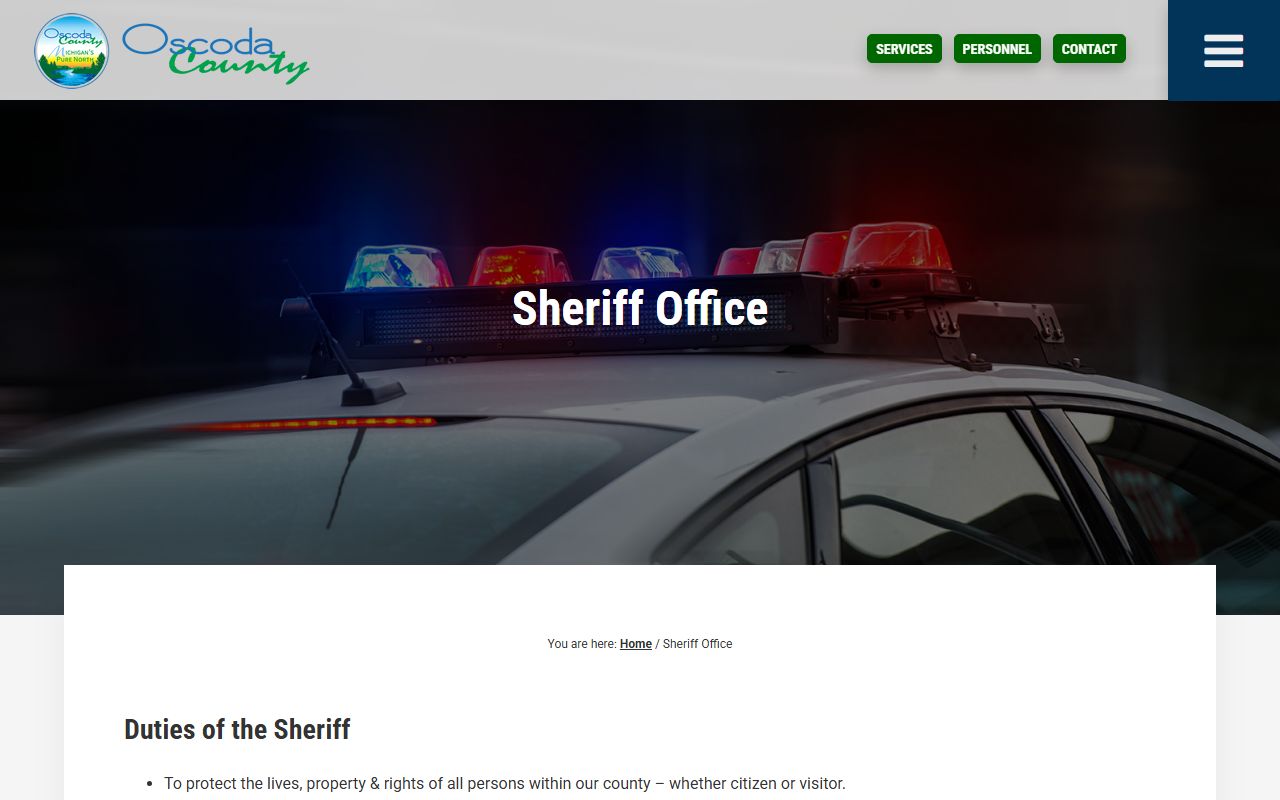
The page confirms the non-emergency number and mailing address a person needs before calling about a warrant. Booking and jail custody are separate from warrant status, and those details appear on the county inmate records resources.
Oscoda County Sheriff's Office
301 S. Morenci Ave.
Mio, MI 48647
Non-emergency: 989-826-3214
Email: sheriff@oscodacountymi.com
Emergencies: 911
Restricted and Sealed Warrant Records
Not every warrant is open to the public. In Oscoda County, a search warrant is frequently sealed before officers carry it out, which keeps the target from destroying evidence. Juvenile matters carry added confidentiality under Michigan court rules. Federal warrants are held by federal agencies and do not appear in county or state systems at all.
Because Oscoda County has no public warrant list, even open warrants take a direct call to confirm. A charge that reaches the felony level moves into the full criminal court records for the county, where arraignment and bond details are recorded. When a record is sealed or restricted, the office holding it will say so rather than release protected details.
Anyone facing a possible arrest should weigh legal help before walking into a courthouse. The Oscoda County Prosecuting Attorney reviews and files charges for the state, while the defense side is separate. Indigent adults who qualify by income and asset guidelines may be represented at no charge by the Northeast Michigan Regional Defender Office, which covers Oscoda, Alpena, and Montmorency Counties. A defense lawyer can confirm a warrant, arrange a surrender, and argue for a reasonable bond before an arrest happens on someone else's schedule.