
How to Search Oscoda County Court Records
Most Oscoda County court records are searched through MiCOURT Case Search, the statewide trial-court portal run by the Michigan judiciary. It can return civil, traffic, criminal, domestic, and probate cases, though what shows publicly depends on the court and the case type. For a same-day view of scheduled matters, the Oscoda County Circuit Court public Court Display lists the day's hearings. When a document is older, not digitized, or needs a raised seal, the county routes the request through the Oscoda County Courts NextRequest portal. Each channel does a different job, so it helps to match the tool to the record.
Gather a few details before you start. A party's full name speeds a name search, and a case number pulls the exact file. Michigan's public web access is narrow. State court materials say online access is limited to case number, party names, and the case history, also called the register of actions. The full paper or electronic file sits at the court counter, not on the public site. That gap is why a search often ends with a formal copy request rather than a download.
- Open MiCOURT Case Search and pick the court. For Oscoda County that means the 23rd Circuit Court, the 81st District Court, or the Probate Court. Circuit hears felonies, civil claims over $25,000, and domestic cases; District hears misdemeanors, traffic, small claims, and landlord-tenant matters; Probate covers estates and guardianships.
- Search by party name or case number. When the case number is unknown, use full names. Do not lean on ICHAT to replace a court search, since the state criminal-history tool leaves out warrants, traffic, juvenile, federal, tribal, and local misdemeanor records.
- Check the Circuit Court Display for the day's hearings. It confirms the party name, hearing time, hearing info, case number, and CTN, but it does not hand over pleadings. Treat it as a calendar snapshot, not a full file.
- Request copies through NextRequest when a file is not online. Include the case number, the party names, and a date of birth for the party if the case number is unknown.
- For in-person help, call Central Filing at 989-826-1111 for circuit matters, or 989-826-1105 for district matters. Phone beats the general county contact form, which the county warns is not checked every day.
The county's request workflow lives on the official Oscoda County Courts NextRequest landing page, pictured here. This screen lets a resident open a new court records request, track its status, and read staff-posted documents such as fee sheets, local orders, and jury information.
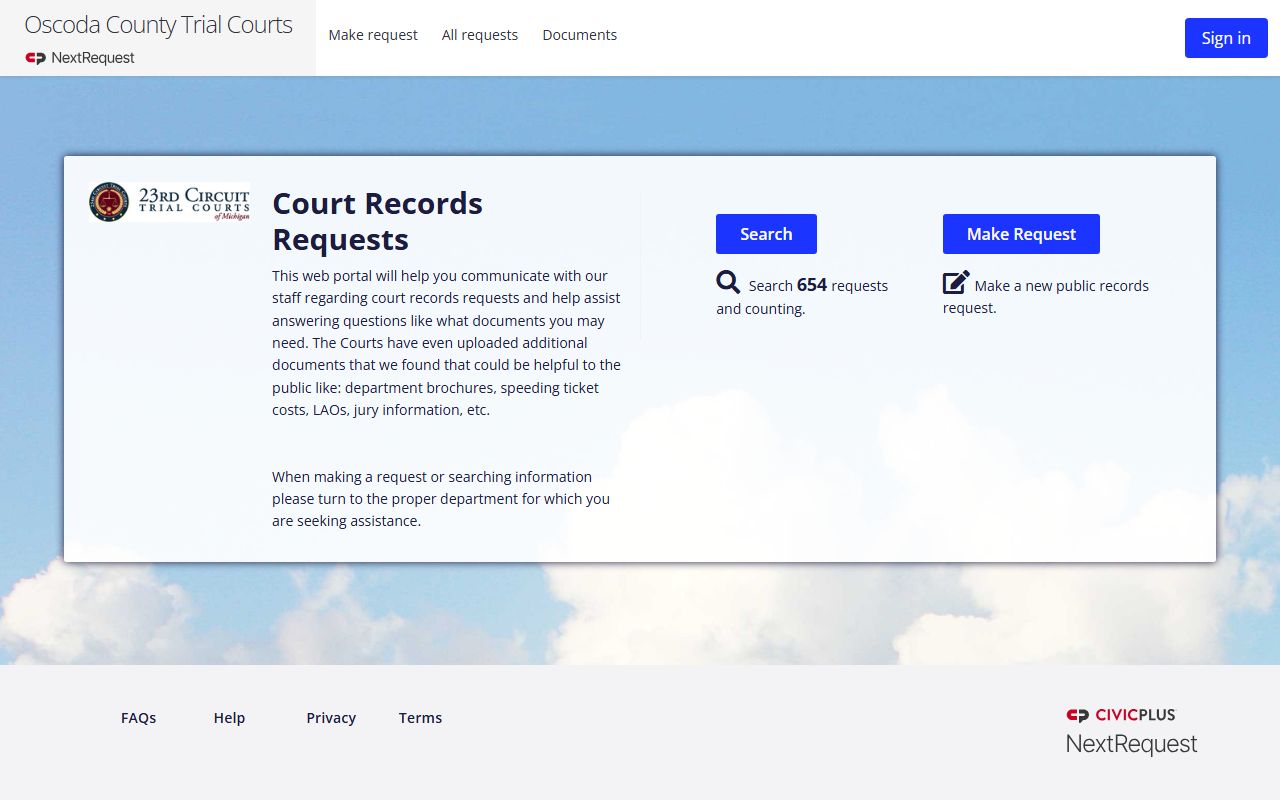
The portal keeps a public log of past requests, so a similar record may already be answered without a new filing.
Oscoda County Court Records Search Fields
MiCOURT Case Search uses a small set of fields, and knowing them keeps a search tight. The court selector matters most, because Oscoda County cases can sit in the circuit, district, or probate court. A name search works when the case number is missing, while a case-number search jumps straight to one file. Date-of-birth entry may be limited by Michigan court-rule changes that protect personal identifiers. The table below lays out the fields a public user typically meets.
| Field Label | Type | Required | Notes / Format |
|---|---|---|---|
| Court | Dropdown / selector | Yes or context-driven | Select a Michigan trial court; Oscoda County may include circuit, district, and probate courts. |
| Case Search Type | Tab / radio | Unspecified | Common modes are name search and case-number search; availability varies by court. |
| Last Name / Business Name | Text | Yes for name search | Use the exact or close party name; wildcard rules are not published. |
| First Name | Text | Optional | Narrows a person search. |
| Case Number | Text | Yes for case-number search | Use the court-issued number; format varies by court and case type. |
| Date of Birth | Date / text | Optional or restricted | Access to personal identifiers may be limited; NextRequest asks for a DOB when the case is unknown. |
| Court Type / Case Type | Dropdown / filter | Optional when shown | Civil, traffic, criminal, domestic, or probate, depending on the court. |
| Search | Button | N/A | Submits the query. |
Types of Oscoda County Court Records
Oscoda County court records fall into a few broad groups, and each group comes from a specific court. The 23rd Circuit Court builds the civil files over $25,000, the felony and serious-misdemeanor files, and the domestic-relations files. The 81st District Court builds the misdemeanor, traffic, small-claims, and landlord-tenant files, plus the early stages of felony cases. The Probate Court holds estate, guardianship, conservatorship, and mental-health files. Family Division records for delinquency and child protection carry tighter access rules.
Which court produced a record shapes what a search returns and where copies come from. A felony can appear in both a district file and a circuit file, because the case starts with a district arraignment and preliminary exam, then moves up on bindover. Traffic and small-claim disputes stay in the district court. Estate and guardianship matters stay in probate.
- Civil records: complaints, answers, motions, orders, judgments, and post-judgment collection filings.
- Criminal records: complaints, arraignment and bond entries, pleas, trial results, sentences, and the register of actions.
- Traffic records: citations, findings, pleas, fines, costs, and abstracts sent to the Secretary of State.
- Family and domestic records: divorce, custody, parenting time, and support files, some with confidential parts.
- Probate records: wills, estate inventories, letters of authority, guardianship, and conservatorship papers.
The daily Oscoda County court dockets pull from these same case files, showing which matters are set for a hearing on a given day.
What Oscoda County Court Records Show
A public court search rarely shows the full file. It shows index-level facts that point you to the record. The Oscoda County Circuit Court Display is a clear example, since its columns match the fields most users need to confirm a case. The table below breaks down a typical display entry and what each field tells you. Note that the display carries no downloadable pleadings and no fine or cost totals, which stay in the paper or electronic file.
| Field | What It Shows |
|---|---|
| Court | Names the Oscoda County Circuit Court as the court holding the matter. |
| Judge | Lists the assigned judge, David C. Riffel or Casandra Morse-Bills. |
| Party Name | The person or business on the scheduled matter. |
| Time | The scheduled hearing time for that day. |
| Hearing Info | The hearing type or location detail. |
| Case Number | The court case number used to pull the full file. |
| CTN | The criminal tracking number, shown when the matter is criminal. |
| Register of Actions | The event-by-event case history, priced at $1 per page on request. |
A criminal case file goes much deeper than the display. Beyond the fields above, it can hold the complaint, the warrant, the arraignment and bond order, the probable-cause conference, the preliminary examination, the information, motions, the plea, trial entries, the verdict, and the sentencing order. That full picture, including the outcome, lives in the Oscoda County criminal court records rather than on the calendar display.
Public Access Framework for Oscoda County Court Records
Court records in Oscoda County are open by default, but they run on court rules, not the state's open-records law. Michigan's Freedom of Information Act, MCL 15.231 et seq, covers most public bodies. The Michigan Attorney General's FOIA page explains that the judiciary is not a public body under FOIA when it acts in its judicial role. That means a FOIA letter is the wrong tool for a court file. Instead, access flows through MCR 8.119, the court rule that governs court records, clerk duties, and public access.
The rule most people read about court records access is the Michigan Court Rule on records management, shown on the state's records-management page. The same page notes that public web access is limited to case number, party names, and case history.
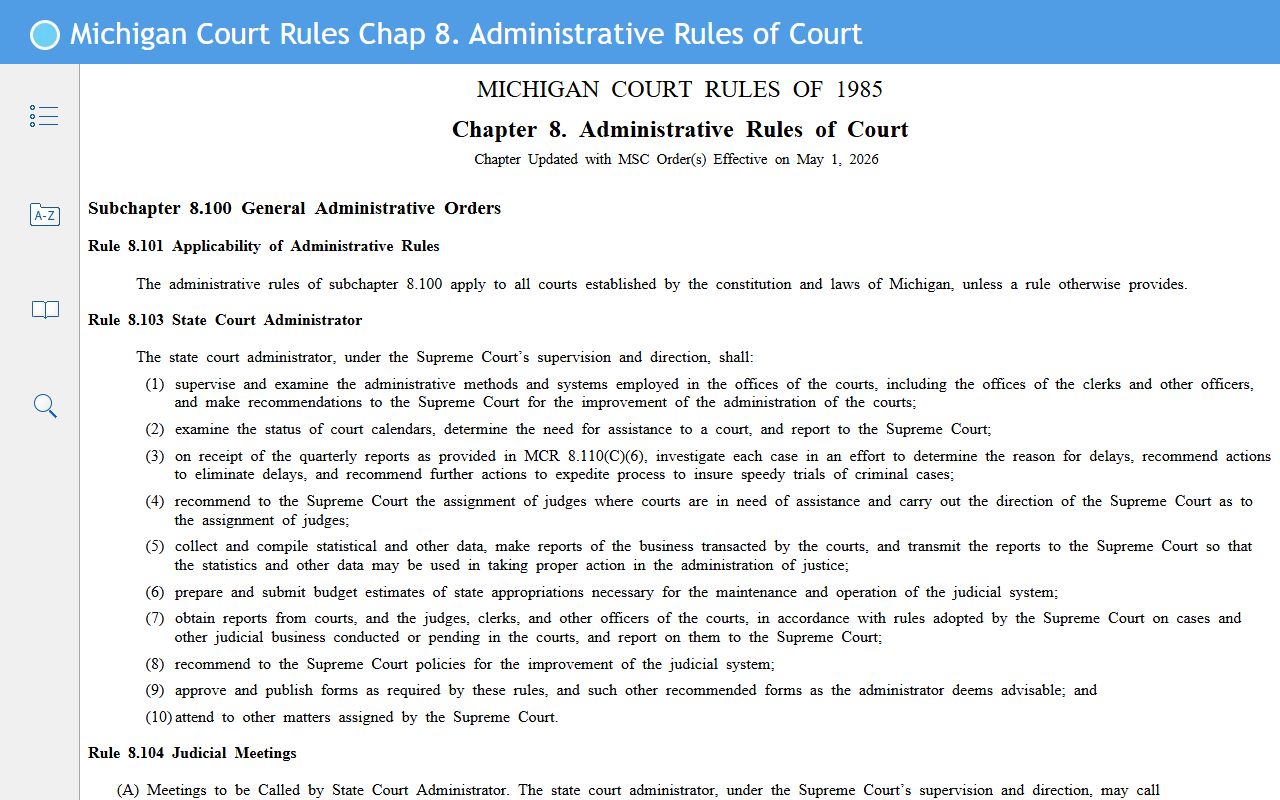
Because MCR 8.119 controls the file, a copy or certified-record request goes to the court through NextRequest or the counter, not through a FOIA letter.
Sheriff and other executive records are different. Those do use FOIA, and the county publishes a sheriff request letter for them. The distinction trips up many searchers who assume one law covers every county record. A quick way to think about it: if a judge's office keeps the file, use court rules; if the sheriff or a county department keeps it, use FOIA.
The Michigan FOIA statute itself sits on the state legislature site and spells out how executive requests work, shown here.
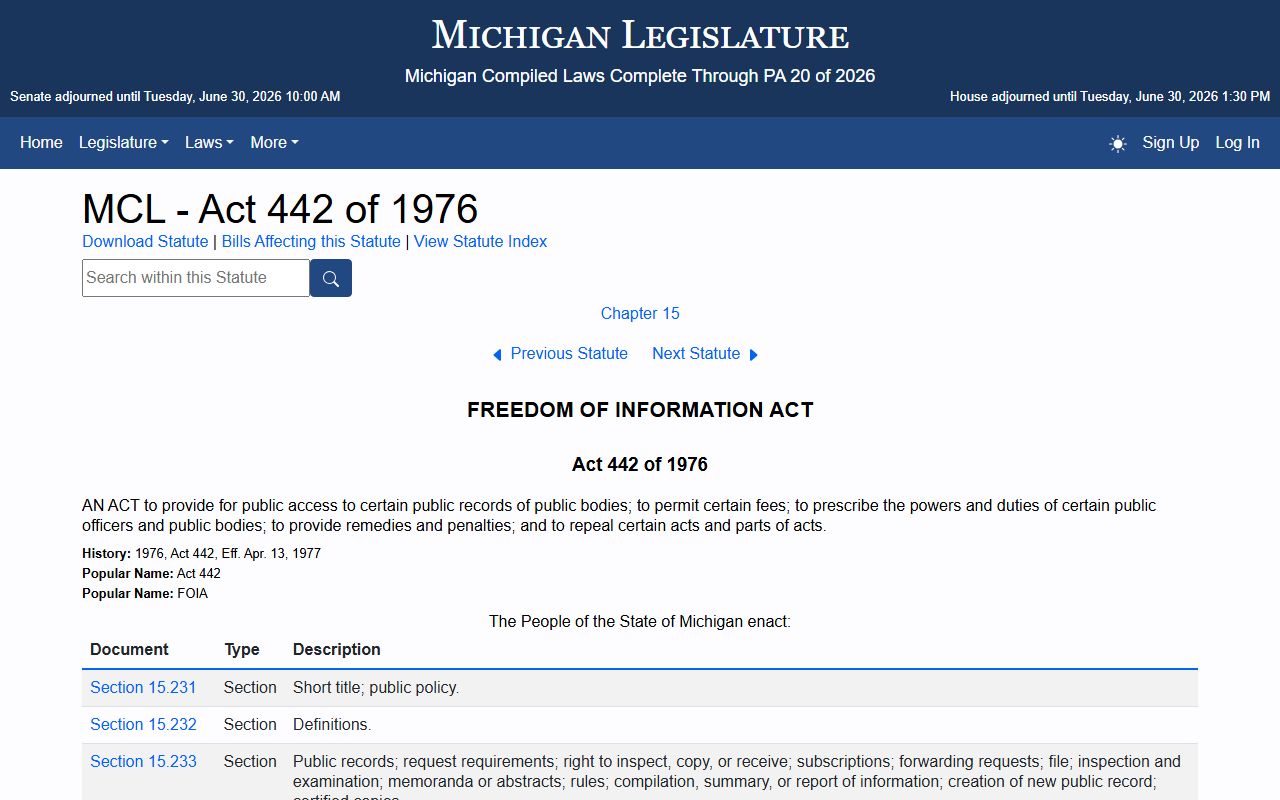
Reading it makes the split clear, since the definition of a public body is exactly what leaves the judiciary out.
Note: A FOIA letter cannot force a court to hand over a case file, so route court copy requests through NextRequest or the court counter instead.
Records That Are Sealed or Confidential in Oscoda County
Not every court record is open, and a public case entry does not mean every attachment is available. Michigan law and court rules pull several categories out of ordinary public view. Juvenile delinquency and child-protective files carry heavier restrictions than adult criminal files. Adoption records are generally confidential. Mental-health files in probate can hold medical and treatment information limited by statute. Courts also restrict personal identifiers such as Social Security numbers, financial account numbers, and information about minors.
Set-aside convictions form another restricted group. Michigan calls expungement relief a set aside, governed by MCL 780.621 with procedures in MCL 780.621d. The state's Clean Slate changes took effect April 11, 2021, and they let more offenses come off public search by application or by an automatic process. A set-aside does not erase every trace. It makes a qualifying record nonpublic for most background and public-search purposes, while courts, law enforcement, and other authorized agencies may still see it under law. Filing fees and exact forms should be confirmed with the convicting court before filing.
Federal Court Records for Oscoda County
Some cases tied to Oscoda County never reach the county courthouse. Federal crimes, federal civil suits, and bankruptcy filings go to the U.S. District Court for the Eastern District of Michigan, Northern Division, with court held at Bay City under 28 U.S.C. 102. These files are not in MiCOURT or NextRequest. The main federal system is PACER, and searchers can start with the PACER Case Locator to find a case across federal courts.
The federal locator lets a user search party names across districts before opening a paid docket, shown here.
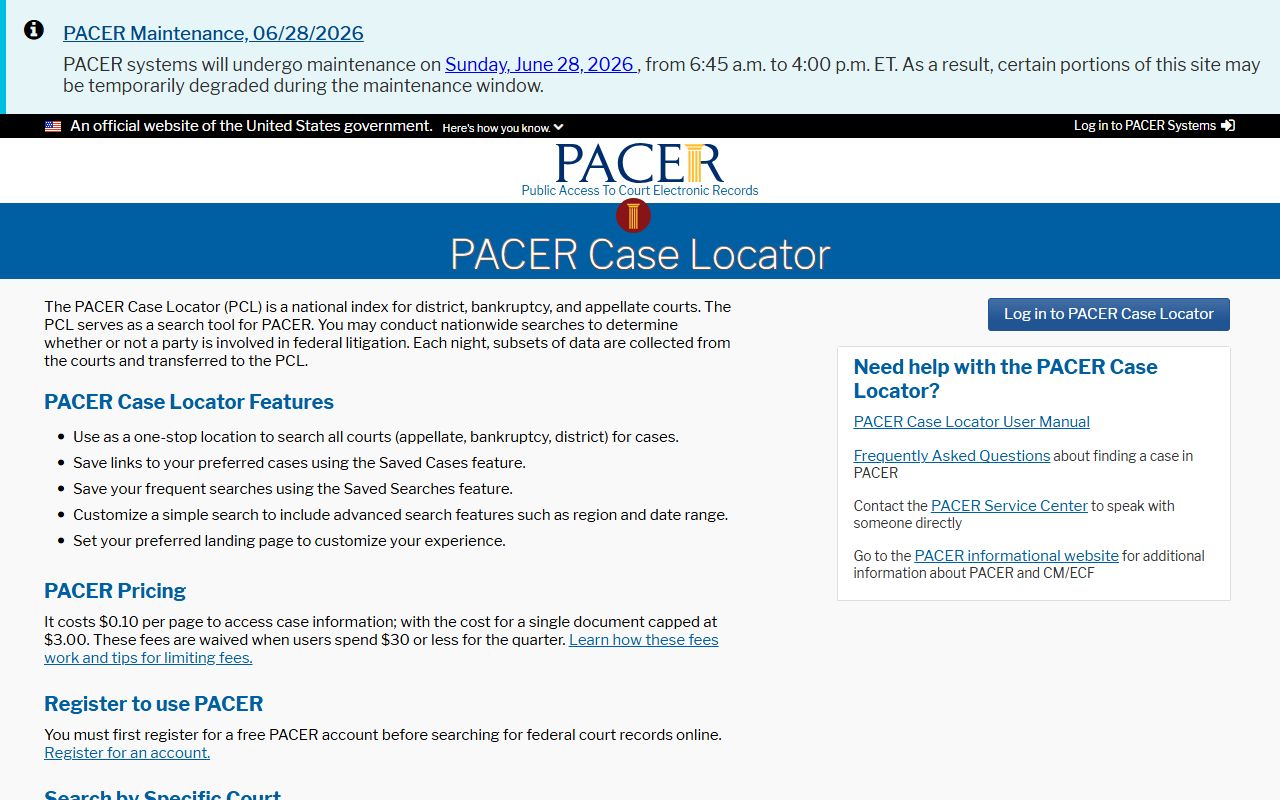
Because PACER charges per page, many people first check a free option for opinions and filings.
For free access to many federal opinions and filed documents, CourtListener hosts court opinions and RECAP documents pulled from PACER. It is not the official docket and may not hold every filing, so a certified copy still comes from the court.
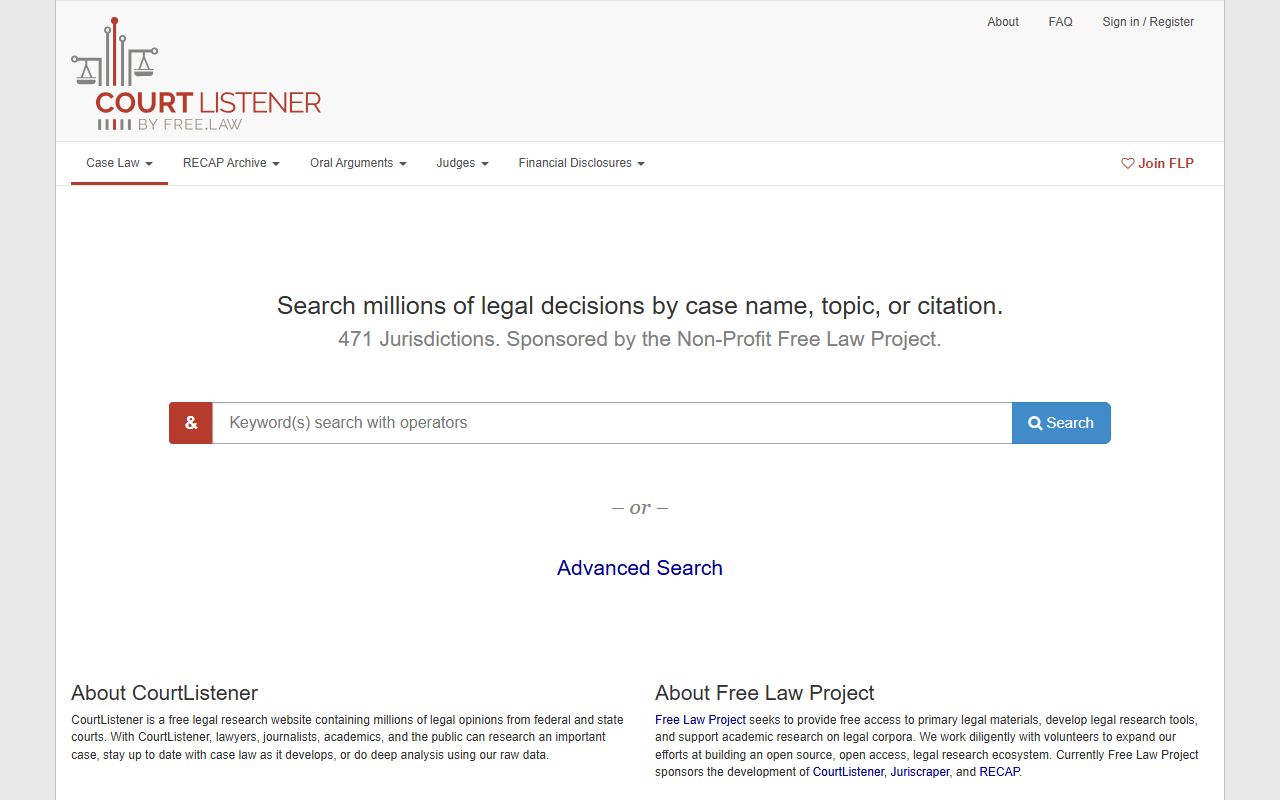
It is a useful first stop for reading a decision, then confirming details in the official record.
In-Person and Mailed Court Record Requests
When a record is not online, the counter and the NextRequest form fill the gap. Court records are handled by the court, not the clerk's vital-record counter, so a birth or marriage copy from the Oscoda County Clerk / Register of Deeds is a separate errand from a case-file copy. Circuit filings and copies run through the Central Filing Office at 105 Court Street in Mio. A request needs the case number, the party names, and a date of birth when the case number is unknown. The new-request form on NextRequest is shown below.
The NextRequest new-request form collects the case number, party names, and a party date of birth if the case is unknown.
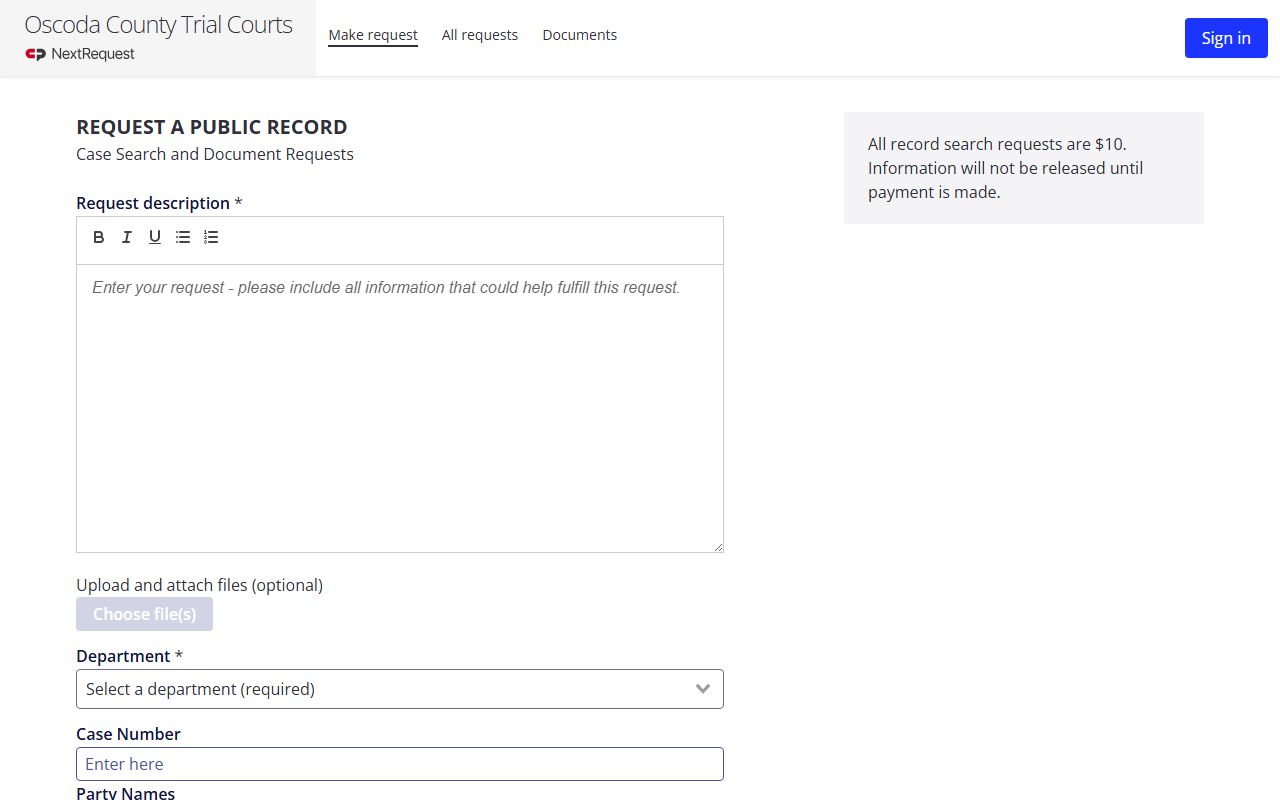
Filling those fields fully lets court staff match the file and quote the correct fee.
Fees come from the court's published schedule. Copies of filed documents cost $1 per page, certified copies cost $10 plus $1 per page, and a search that requires creating a new written record costs $10. The court does not take personal checks. It accepts cash, money orders, and certified checks, while credit-card payments run through AllPaid rather than the courthouse counter.
| Item | Fee |
|---|---|
| Criminal record search requiring a new written record | $10 |
| Civil record search requiring a new written record | $10 |
| Certified copy of conviction, judgment, or filed document | $10 + $1/page |
| Noncertified copy of a filed document | $1/page |
| Copy of a court form | $1/page |
| Copy of the register of actions | $1/page |
Oscoda County Central Filing Office
105 Court Street
Mio, MI 48647
989-826-1111
Mon-Fri 8:30 a.m.-4:30 p.m.
Note: Public online results show only case number, party names, and case history, so a certified copy or full filing still requires a counter visit or a NextRequest submission.