
Criminal Court Records in Oscoda County
A criminal court record in Oscoda County is the full case file a court opens once a prosecutor files a charge. The file grows as the case moves. It starts with the complaint and any warrant or summons, then adds the arraignment record, bond order, motions, hearing notices, plea, trial entries, verdict, and the final sentence. Court staff keep this file, not the police. The court offices at the Mio courthouse maintain the paper and electronic case records and log every filing in a register of actions. That register is the running index of a case, and it is where most criminal record searches begin.
Two trial courts build the criminal record here. The 81st District Court handles misdemeanors and the early stages of felony cases. The 23rd Circuit Court, which also serves Alcona, Arenac, and Iosco Counties, takes felony and serious misdemeanor cases after bindover. A felony often has both a district file and a circuit file. That split matters when you search, because one name can produce records at two court levels. The district court sets bond, holds the first hearings, and decides whether a felony has enough proof to move up.
How to Search Oscoda County Criminal Court Records
Most Oscoda County criminal court records can be checked online at no cost. The statewide MiCOURT Case Search tool returns basic case information from Michigan trial courts, including party names, case numbers, and case history. For same-day hearings, the Oscoda County Circuit Court Display lists party name, time, hearing information, case number, and the CTN used to track criminal matters. Copies and certified records come from the court through the Oscoda County Courts NextRequest portal.
- Open the MiCOURT Case Search portal and pick a trial court or search across courts.
- Enter the defendant name or, if known, the case number. A date of birth helps narrow common names.
- Filter by court, case type, and filing date to separate criminal cases from civil or traffic files.
- Open the case to read the register of actions, the charges, the plea, and the disposition.
- Request a certified copy of a conviction or judgment from the court when a signed record is needed.
Online tools show case history, not full pleadings. The public web view is limited to case numbers, party names, and the register of actions. To read motions, orders, or a sentencing document, submit a request through NextRequest or visit the court counter in Mio. A criminal record search costs $10 at the court. A certified copy of a conviction runs $10 plus $1 per page.
Stages of an Oscoda County Criminal Case
A criminal case moves in a set order, and each step leaves a mark in the record. Felonies and misdemeanors follow slightly different paths, but the felony route shows the full sequence. Reading the stages in order helps make sense of the docket entries and the dates tied to each one.
Case flow: Charges Filed › Arraignment / Probable-Cause Conference › Preliminary Examination › Bindover › Plea or Trial › Disposition › Sentencing
- Charges Filed
- The prosecutor authorizes a complaint that names the offense, the statute, and the defendant.
- Arraignment / Probable-Cause Conference
- The court reads the charge, advises rights, and sets bond. A probable-cause conference is a Michigan felony event held in district court before the exam.
- Preliminary Examination
- A district-court judge decides whether there is enough proof to send a felony to circuit court.
- Bindover
- When proof is found or the exam is waived, the felony transfers from district court to circuit court.
- Information
- After bindover the prosecutor files the information, the formal felony charging document read in circuit court.
- Plea or Trial
- The defendant pleads guilty, no contest, or not guilty, or the case goes to a jury or bench trial.
- Disposition
- The record shows the result of each count: conviction, dismissal, or acquittal.
- Sentencing
- After a conviction the judge imposes the sentence, which may include jail, prison, probation, fines, costs, and restitution.
What an Oscoda County Criminal Court Record Shows
An Oscoda County criminal court record is more than a name and a charge. The file gathers identifying details, every count, and the money and supervision ordered at the end. Some fields appear in the public online view, while others sit in documents held at the court. The fields below run across both district and circuit criminal files.
| Field | What It Shows |
|---|---|
| Case Number | Unique court number that identifies the file and its court level. |
| CTN | Charge tracking number that links the case across agencies and courts. |
| Defendant | Name and identifying details of the person charged. |
| Charges | Each count, the statute cited, and the offense level. |
| Bond | Amount or conditions set to secure the defendant's return to court. |
| Plea | The defendant's answer: guilty, not guilty, or no contest. |
| Disposition | The result of each count, such as conviction, dismissal, or acquittal. |
| Sentence | Jail, prison, probation, fines, costs, and restitution ordered after conviction. |
| Register of Actions | Dated list of every filing and hearing in the case. |
Statewide Criminal History and ICHAT
A single county file does not show a person's full history. For a statewide picture, Michigan uses ICHAT, the Internet Criminal History Access Tool run by the Michigan State Police. ICHAT reports public criminal-history convictions from Michigan police agencies and courts for a fee. It is a repository, not a case file, so it will not show the motions, orders, and hearing detail that a court record holds.
The state explains ICHAT coverage and its limits on the Michigan State Police criminal history records page.
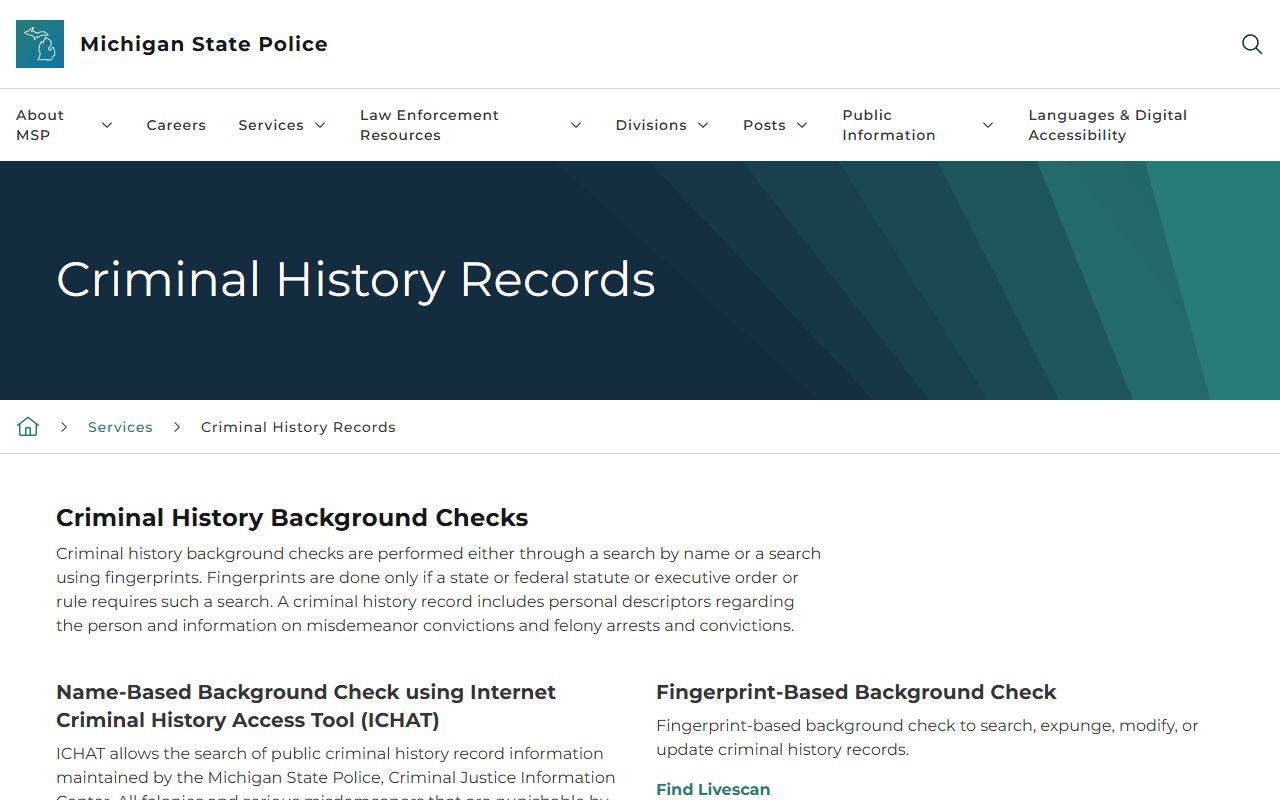
That page also lists what ICHAT leaves out, which is why it cannot replace a look at the Oscoda County court file. ICHAT has real gaps, and several record types stay off a statewide history report even when a court or another agency still holds them.
- Warrants and pending arrests
- Traffic records
- Juvenile records
- Federal records
- Tribal records
- Local ordinance misdemeanors
- Criminal history from other states
Note: ICHAT reports convictions on a fee basis and does not confirm whether a person currently has an open warrant.
Charges vs. Convictions in Oscoda County Records
Being charged is not the same as being convicted, and a criminal court record can show both. A file may list a charge that was later dropped, reduced, dismissed, or that ended in an acquittal. The charge is only the accusation. The conviction is the court's finding of guilt by plea or verdict. The charging documents, and how a count can be amended or dismissed, are covered in the Oscoda County arrest and court charge records.
| Charge | Conviction | |
|---|---|---|
| Stage | Accusation filed | Final finding of guilt |
| Proof Needed | Probable cause | Beyond a reasonable doubt |
| Who Acts | Prosecutor files | Judge or jury decides |
| Can Change | Amended, reduced, or dropped | Stands unless appealed or set aside |
| Public Record | Yes | Yes |
Prosecutor and Public Defense
Charges in Oscoda County come from the elected Prosecuting Attorney, not the police. The prosecutor reviews police reports, decides what to authorize, and carries the case through district, circuit, and family courts. That office is the reason a charge appears in the criminal record at all, and its decisions shape whether a count is filed as a felony or a misdemeanor.
Kristi McGregor serves as the county prosecutor, and her duties are listed on the Oscoda County Prosecuting Attorney page.
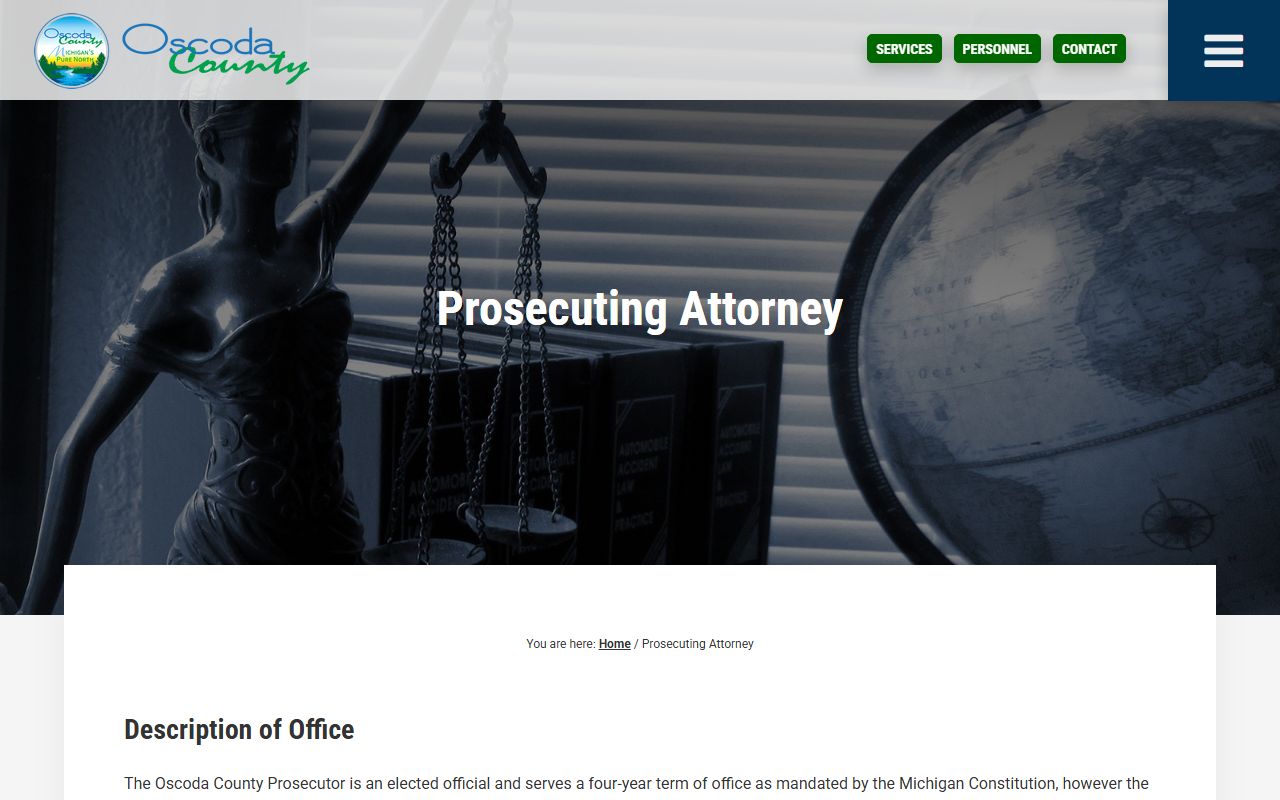
The office also supports crime victims and files child-support and paternity matters alongside criminal cases.
Oscoda County Prosecuting Attorney
Kristi McGregor
Phone: 989-826-1120
Hours: Mon to Fri 8:30 a.m. to 4:30 p.m. (closed 12 to 1)
A defendant who cannot afford a lawyer has a right to appointed counsel. In Oscoda County that work goes to the Northeast Michigan Regional Defender Office, a nonprofit that represents indigent adults charged with crimes in Alpena, Montmorency, and Oscoda Counties. The office does not charge for service, though a client may owe court costs if a waiver is denied. Applicants must meet income and asset guidelines, and questions go to 989-354-2856.
Sealed vs. Set-Aside Records in Michigan
Michigan does not use the word expungement in its statutes. The state term is set aside. A set-aside makes an eligible conviction nonpublic for most background-check and public-search purposes. It does not erase every trace. Courts, law enforcement, and certain authorized agencies keep access under law. Sealing is a narrower step a judge can order over specific court documents in a case.
Michigan's Clean Slate program explains how courts handle set-aside records on the Michigan Courts Clean Slate page.
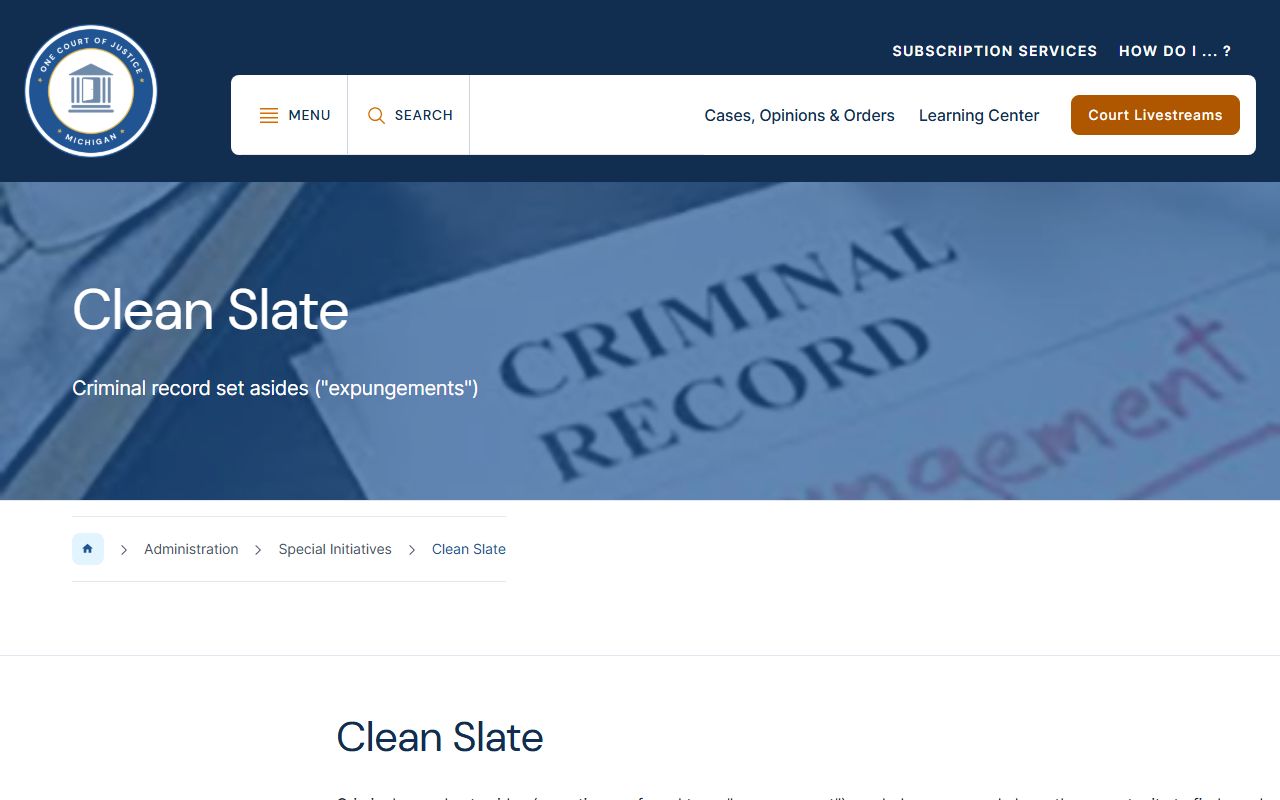
Those changes took effect April 11, 2021 and widened the offenses and the number of convictions that can be set aside. Some records also clear automatically without a filing.
| Sealed | Set Aside (Michigan) | |
|---|---|---|
| Effect | Specific documents hidden by court order | Conviction removed from ordinary public access |
| Law Enforcement | Retains access | Retains access |
| What Remains | Case may still appear publicly | Record kept for official use, not public search |
| How It Happens | Judge's order on a filing | Application under state law or automatic process |
Applying to Set Aside a Conviction
Setting aside a conviction follows a set path, and it starts with the convicting court. An applicant first confirms the conviction and checks whether it qualifies. Eligibility rules and waiting periods sit in Michigan's set-aside statutes.
The core eligibility rules are in MCL 780.621, the state's set-aside statute.
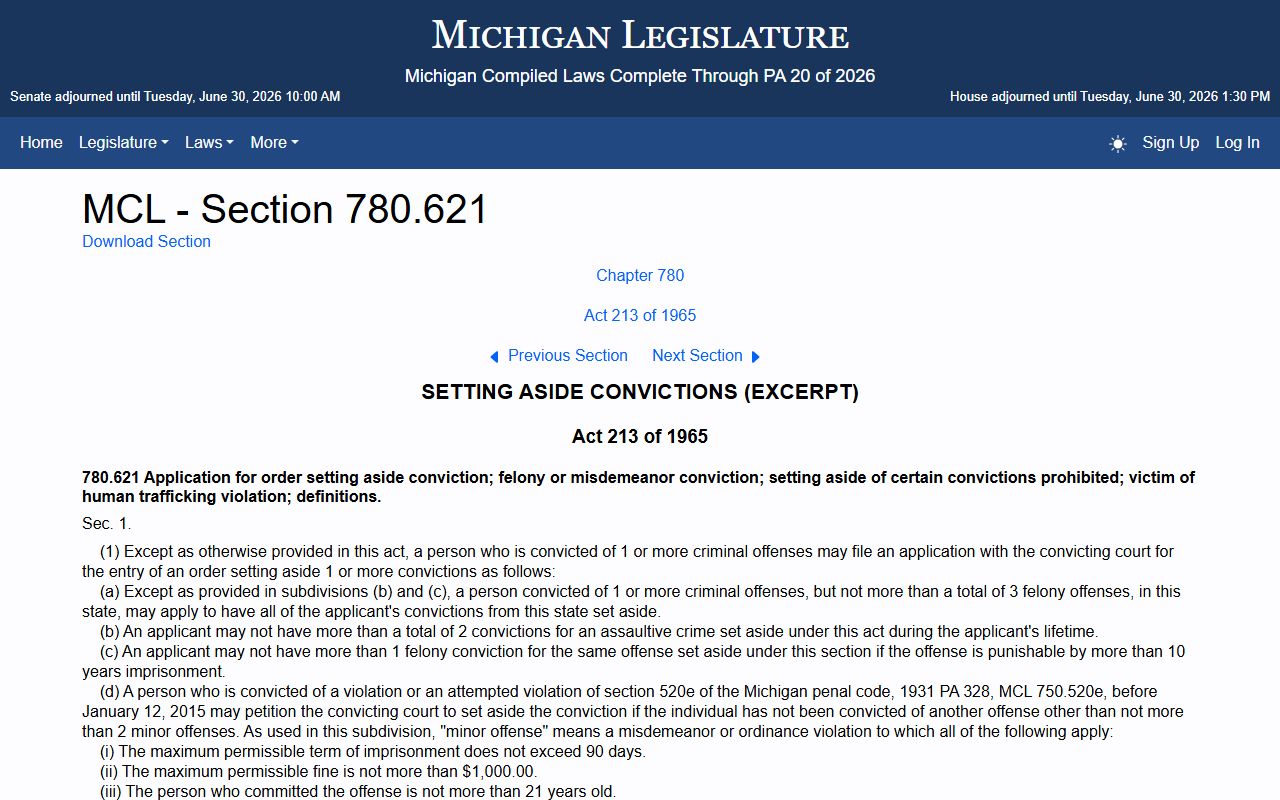
It lists which convictions can be cleared and the waiting periods that apply before a person may file.
- Identify the conviction in the court file or through ICHAT and note the statute and date.
- Check eligibility under MCL 780.621 and current Clean Slate rules.
- Complete the state set-aside forms for the convicting court.
- Meet the service, fingerprint, background-check, and prosecutor-notice requirements.
- Attend any hearing the court sets, then wait for the judge's decision.
The steps and paperwork for felonies and serious misdemeanors appear in MCL 780.621d, the procedure statute.
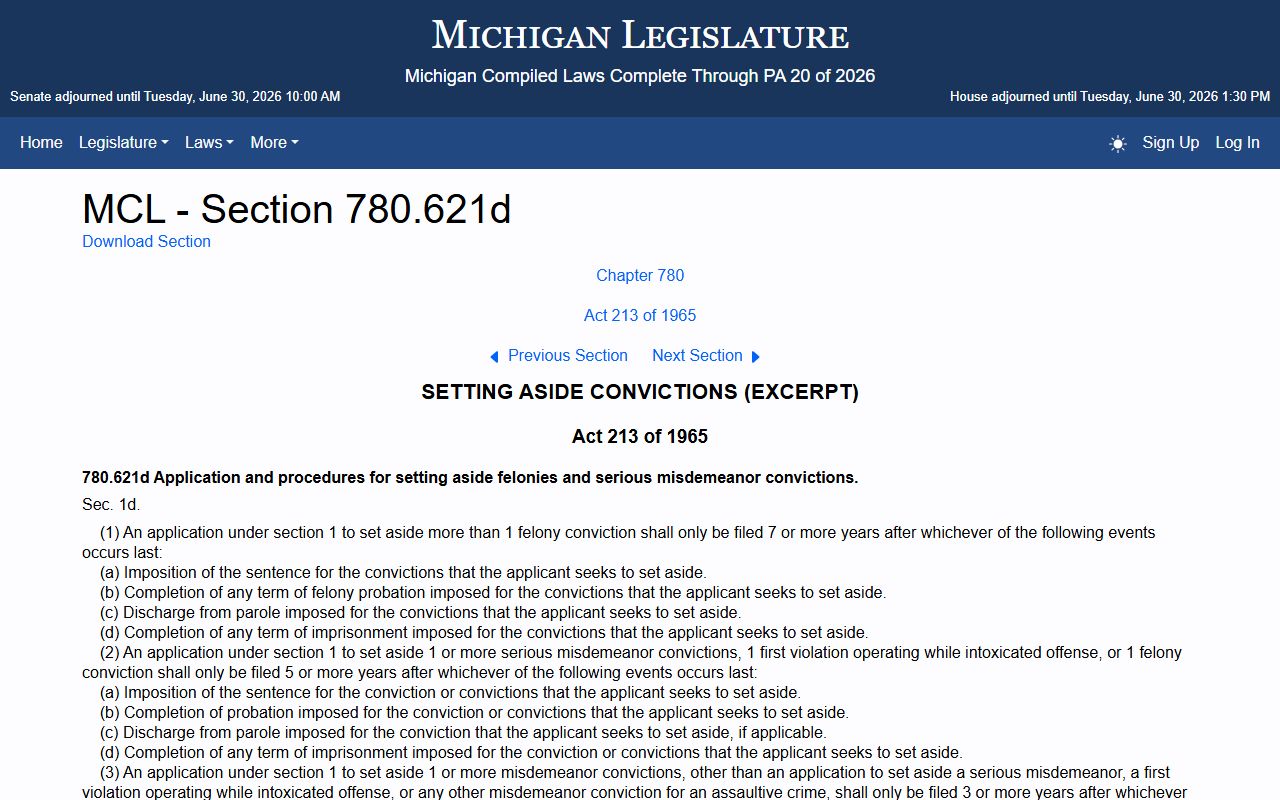
Filing fees and exact forms should be confirmed with the convicting court before an application is filed. A set-aside makes a qualifying conviction nonpublic for most public searches, but it does not promise that every record disappears.
Public Access to Oscoda County Criminal Records
Most Oscoda County criminal court records are open to the public. Michigan court files are governed by court rules, not by the state Freedom of Information Act. The judiciary is left out of the FOIA definition of a public body, so a criminal case file is requested through the court, not through a FOIA letter. Sheriff records follow FOIA, but court records do not.
Key rules and laws:
MCR 8.119 - Michigan court rule that governs court records, clerk duties, and public access to case files.
Michigan FOIA, MCL 15.231 et seq - General records law that covers county offices but excludes the courts acting in a judicial role.
Note: The public online view is limited to case numbers, party names, and the register of actions, so full pleadings need a court request.
Restricted Oscoda County Criminal Records
Some criminal matters never reach public search. The court closes or limits certain files by statute or court rule, and a public case entry does not mean every attachment is available.
- Juvenile delinquency and child-protective cases in the family division
- Convictions that have been set aside or sealed
- Records with personal identifiers such as Social Security or financial account numbers
- Mental-health commitment files handled in probate court
- Ongoing investigations and documents a judge has ordered nonpublic
Beyond criminal cases, the wider mix of civil, family, and probate files is described in the Oscoda County court records overview.