
What Probate Covers in Oscoda County
Probate is the court process for settling a person's affairs and protecting those who cannot protect themselves. In Michigan, the Probate Court is a separate trial court, and in Oscoda County it handles estates, wills, trusts, and protective proceedings from the county seat in Mio. When someone dies, the court oversees how their property, debts, and wishes are carried out. When a child or an adult cannot make safe decisions, the court can appoint someone to help.
The range of cases is broad. Oscoda County probate records grow out of many different life events, and each case type follows its own set of forms and rules.
- Estates of people who died with or without a will
- Will deposits and formal will filings
- Trusts and trust administration disputes
- Guardianships for minors and for incapacitated adults
- Conservatorships that protect a person's money and property
- Guardianships for developmentally disabled individuals
- Mental-health treatment and commitment proceedings
Because these matters touch families across Oscoda County, the probate files can hold deeply personal information. Oscoda County probate records sit at the center of estate planning, inheritance, and family protection. Some of it is open to the public, and some of it stays sealed by law.
Oscoda County Probate Terms Defined
Probate paperwork uses words that rarely come up in daily life. A short glossary helps when reading an Oscoda County probate file or talking with the court. These five terms appear in most estate and protective cases.
- Testator
- The person who wrote and signed a will. The will speaks for the testator after death.
- Executor
- The person named in a will to carry out its terms. Michigan often calls this role the personal representative.
- Intestate
- Dying without a valid will. State law then decides who inherits the estate.
- Guardianship
- A court order that puts one person in charge of the personal care and welfare of a minor or an incapacitated adult.
- Conservatorship
- A court order that puts one person in charge of the money and property of someone who cannot manage their own finances.
Note: Guardianship covers a protected person's care and living needs, while conservatorship covers their money, and one case can involve both roles.
What Oscoda County Probate Records Show
An Oscoda County probate estate file tells the full story of how an estate was opened, managed, and closed. The papers build up over months as the personal representative reports to the court. Guardianship and conservatorship files follow a similar arc, with added reports on the protected person's condition and finances.
An estate file in Oscoda County can include the application or petition to open the estate, the death certificate, the will and any codicil, the acceptance of appointment, letters of authority, notice to heirs, proofs of service, an inventory of assets, accountings, claims by creditors, objections, court orders, receipts, and closing statements. A guardianship or conservatorship file can add physician or mental-health evaluations, guardian ad litem reports, annual reports, and account statements.
A public case search will not always show every document. Michigan online access is generally limited to case numbers, party names, and the register of actions, which is the running list of filings and orders. The table below reflects the fields a probate case record is expected to carry, based on Michigan practice and the court's copy access.
| Field | What It Shows |
|---|---|
| Case number | The unique identifier assigned to the probate matter. |
| Case caption | The estate or protected-person name the case is filed under. |
| Case type | Estate, guardianship, conservatorship, trust, or mental health. |
| Filing date | When the petition or application opened the case. |
| Petitioner | The person or party who asked the court to act. |
| Decedent or protected person | The person whose estate or welfare is at issue. |
| Attorney and judge | Counsel of record and the assigned judicial officer. |
| Hearing dates | Scheduled court dates for the matter. |
| Letters and orders | Appointments and rulings the court has entered. |
| Register of actions | The chronological list of every filing and event. |
Guardianship and Conservatorship Files
Not every Oscoda County probate case is fully open. Oscoda County guardianship and conservatorship files often carry material that state law and court rules keep out of public view. Medical and mental-health records, physician evaluations, and details about minors are the most sensitive parts.
Mental-health treatment and commitment cases sit in the Probate Court as well, and those files can hold diagnosis, treatment, and hospital information. Adoption records tied to family proceedings are confidential too. A person may see the existence of a case and its basic docket while the protected medical content stays sealed. Access is not identical for each file type, so the safest step is to confirm with the court what part of an Oscoda County probate record is releasable before requesting copies.
Important. Do not assume a guardianship or mental-health file is fully public. Medical evaluations, minor information, and protected-person details are commonly restricted even when the case docket is visible.
How to Search Oscoda County Probate Records
There is no single probate-only database for Oscoda County. Public case information runs through the statewide court search, and copies come through the court's records-request portal. Searchers get the best results with a name and, when known, a case number and an approximate filing date.
- Open MiCOURT Case Search and choose the court and case type. MiCOURT may include Oscoda County probate cases depending on court participation, and results are generally limited to case numbers, party names, and case history.
- Search by the decedent or protected-person name. Add the case number if you already have it to narrow the list.
- For copies or a records search the portal does not show, file a request through the Oscoda County Courts NextRequest portal. Include the name, the case number if known, and the approximate filing date.
- Submit the request form at NextRequest new request and specify whether you need certified or plain copies.
- For older files that predate online access, contact probate filing and scheduling staff by phone to confirm the record exists and how to obtain it.
Note: Michigan court records are governed by court rules such as MCR 8.119 rather than the state Freedom of Information Act, because the judiciary is excluded from FOIA.
The Oscoda County Probate Court
Probate filing and scheduling for Oscoda County runs out of the courthouse in Mio. The staff contact listed on the county's court page handles new filings, hearing dates, and copy questions for estates and protective cases. Call before mailing or faxing documents so they reach the right desk.
Oscoda County Probate Court
Probate Filing and Scheduling, Chelsee Heacock
105 S. Court Street
P.O. Box 399
Mio, MI 48647
989-826-1159
Fax: 989-826-1158
The court also connects to the broader Oscoda County record system. Marriage records and vital documents sit with the county's Clerk / Register of Deeds rather than the Probate Court, so a probate search and a vital-record search sometimes run in parallel.
Oscoda County Probate Copy Fees
The Oscoda County court charges the same copy fees for probate documents that it charges for other court files. Certified copies cost more because a clerk verifies them for legal use. A specific probate filing-fee schedule was not published in the county sources reviewed, so verify any petition or application fee directly with the court before filing.
| Item | Amount |
|---|---|
| Certified copy of a filed document | $10 plus $1 per page |
| Non-certified copy of a filed document | $1 per page |
| Register of actions | $1 per page |
The court does not take personal checks. Cash, money orders, and certified checks are accepted, and credit-card payment may be available through the court's approved processor. Confirm accepted methods when placing an Oscoda County probate copy order.
Estate Debt and the Federal Courts
Some estate and debt questions move beyond Oscoda County probate. When a person or an estate cannot pay its debts, the matter can land in federal bankruptcy court instead of, or alongside, an Oscoda County probate case. Oscoda County sits in the Eastern District of Michigan, and its nearest federal division connection is Bay City, not the courthouse in Mio.
The counterpart to county probate for insolvency is shown on the U.S. Bankruptcy Court for the Eastern District of Michigan site.
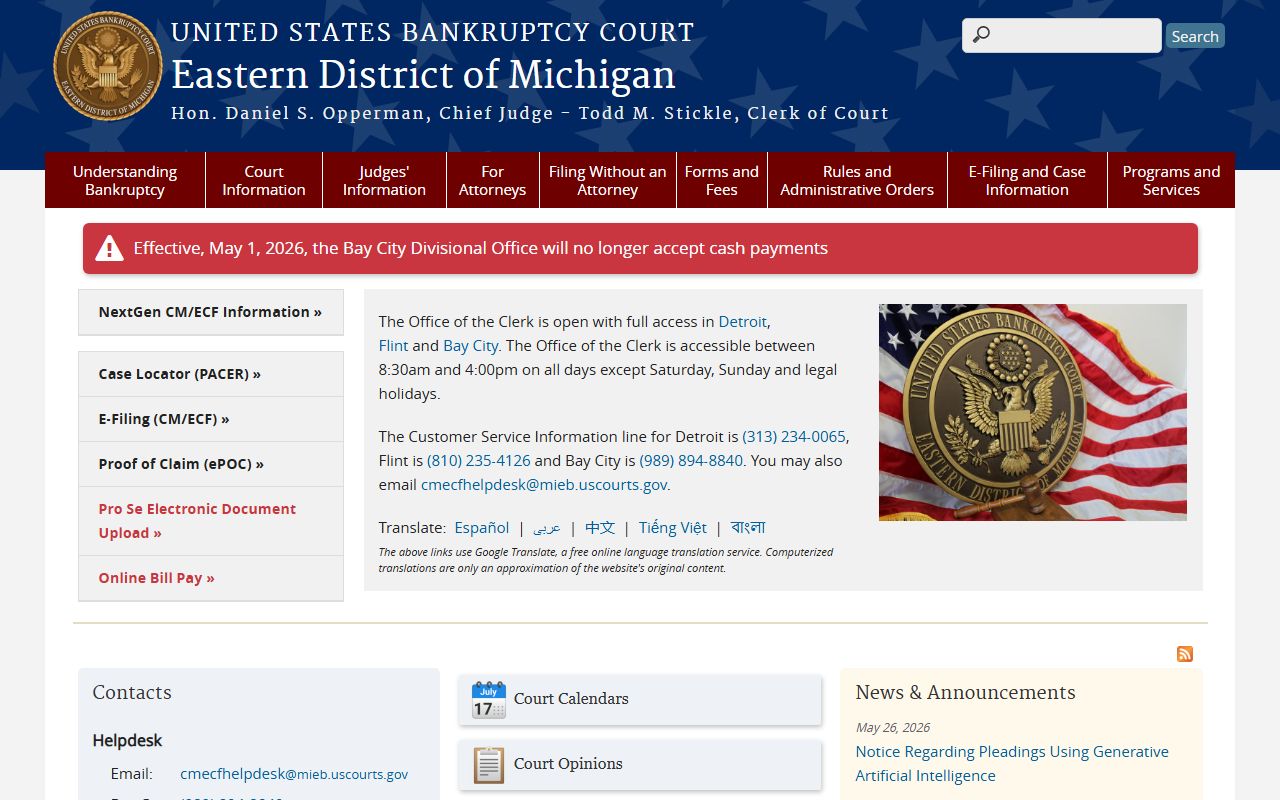
That court handles bankruptcy filings, adversary proceedings, and creditor claims, which can overlap with how an Oscoda County estate settles its debts. Bankruptcy is federal, so it does not run through the county Probate Court, but families dealing with an insolvent estate often need both.
Appeals from federal cases in Michigan's eastern district follow a set path. The U.S. Court of Appeals for the Sixth Circuit hears them from its base in Cincinnati.
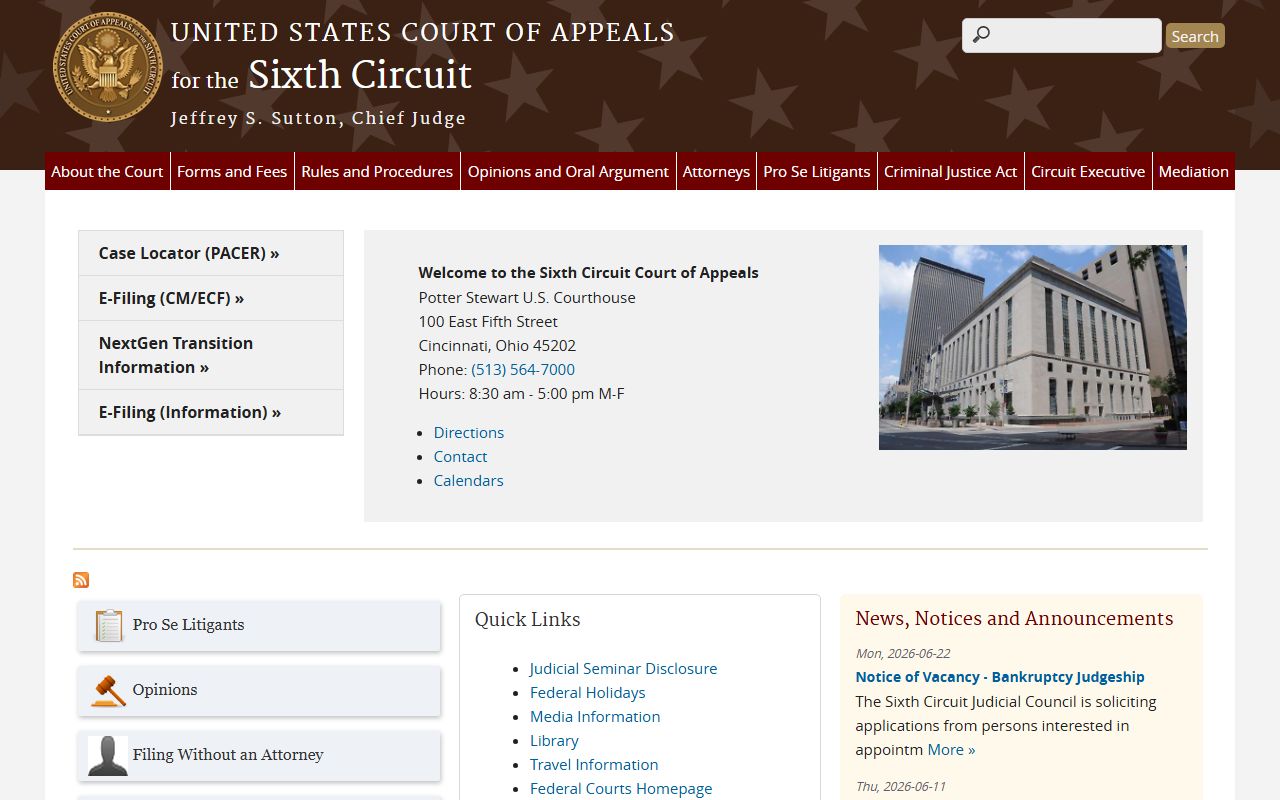
The Sixth Circuit covers Michigan, Ohio, Kentucky, and Tennessee, so a federal bankruptcy or civil ruling touching an Oscoda County estate would be reviewed there, not in the state appellate courts that hear probate appeals.
Federal filings run through an electronic docket rather than a public counter. Attorneys and authorized filers use CM/ECF for the Eastern District of Michigan to submit documents.
Members of the public read those dockets through PACER and search cases with the PACER Case Locator, while CourtListener offers free access to many federal opinions. Federal placement of Oscoda County within the Eastern District appears in 28 U.S.C. 102.
The Oscoda County Probate Process
Opening and closing an Oscoda County probate case follows a predictable order, though routine estates can move faster than contested ones. Knowing the steps helps a family gather the right papers before contacting the court. The path is similar for estates, guardianships, and conservatorships, with case-specific forms at each stage.
- Identify the matter. Decide whether it is estate administration, a will filing, a guardianship, a conservatorship, a trust, or a mental-health case.
- Contact probate filing and scheduling, or pull the correct Michigan Courts and SCAO forms the court directs you to use.
- File the petition or application with the required forms, plus a death certificate or medical documentation where the case calls for it, and pay the filing fee after confirming the amount.
- Serve the interested persons the law requires and file proofs of service with the court.
- Attend the hearing if one is scheduled. Some routine estate matters can proceed without a full hearing.
- After appointment, the personal representative, guardian, or conservator follows court orders for inventory, accounting, reporting, and closing.
- Request certified orders or copies through NextRequest or the probate clerk once the case is on file.
Note: Confirm every filing fee and form requirement with the Oscoda County Probate Court before filing, since specific probate filing fees were not published in the county sources reviewed.