
How to Search Oscoda County Court Records
Most public court files in Oscoda County start with one statewide tool. The MiCOURT Case Search from the Michigan Courts lets you look up trial-court cases by name or case number. Depending on the court, results may cover civil, traffic, criminal, domestic, and probate matters. Public online access is narrow, though. State records rules limit what a court website shows to the case number, party names, and the case history, also called the register of actions. The full paper or electronic file at the counter holds far more.
A second official channel shows the day's hearings. The Oscoda County Circuit Court display lists scheduled matters with party name, time, hearing info, case number, and CTN. When a record is not online, or you need a certified copy, the county routes the request through the Oscoda County Courts NextRequest portal. Have the case number ready if you can. When it is unknown, party names and a date of birth help staff find the file.
The official county homepage is a good first stop for department phone numbers and notices. The Oscoda County government site lists court offices and links each department.

The homepage groups the clerk, circuit court, district court, and sheriff in one place, which shortens the hunt for the right court records contact.
A simple order of steps keeps an Oscoda County court records search on track.
- Open MiCOURT Case Search and pick the right court when prompted. For Oscoda County, that means the 23rd Circuit Court, the 81st District Court, or the Probate Court.
- Search by party name or case number. When the case number is unknown, use full names and, for a NextRequest copy order, add the party's date of birth.
- Check the Circuit Court display for today's hearings. It confirms the party, time, hearing type, case number, and CTN, but it does not offer downloadable pleadings.
- For certified copies, a register of actions, or an older file, file a NextRequest court records request with the case number and names.
- For in-person help, call the Central Filing Office at 989-826-1111 for circuit matters, or 989-826-1105 for district matters, since the general website mailbox is not monitored daily.
The MiCOURT search screen accepts a set of common fields. Availability shifts by court and case type.
| Field | Type | Required | Notes |
|---|---|---|---|
| Court | Dropdown / selector | Yes or context-driven | Pick a Michigan trial court; Oscoda options may include circuit, district, and probate. |
| Case Search Type | Tab / radio | Varies | Name search or case-number search, by court. |
| Last Name / Business Name | Text | For name search | Use the exact or close party name. |
| First Name | Text | Optional | Narrows a person search. |
| Case Number | Text | For number search | Format varies by court and case type. |
| Date of Birth | Date / text | Optional or restricted | Access to personal identifiers may be limited by court rule. |
| Court / Case Type | Dropdown | Optional | Civil, traffic, criminal, domestic, or probate where offered. |
Note: MiCOURT is not the same as MSP ICHAT, which is a criminal-history tool that leaves out warrants, traffic, juvenile, federal, tribal, and local misdemeanor records.
The Oscoda County Judicial System
Michigan runs one statewide court system, and Oscoda County plugs into it through three trial courts. The broadest is the 23rd Circuit Court, one of the largest circuits by area in the state. It covers Alcona, Arenac, Iosco, and Oscoda Counties. Below it sits the 81st District Court, which handles the higher-volume, lower-stakes matters. The Probate Court forms a separate trial court for estates and protective cases. Appeals do not stay local for long. A district decision can be reviewed by the circuit court, while circuit rulings move up to the state appellate courts.
The state maintains a plain overview of how these courts fit together. The Michigan Courts trial-court page describes circuit, district, and probate courts and what each one hears.
That structure explains why an Oscoda County criminal case can leave both a district file and a circuit file: a felony often begins in district court for arraignment, then moves up after bindover.
Case flow: 81st District Court › 23rd Circuit Court › Michigan Court of Appeals › Michigan Supreme Court
| Court | Jurisdiction | Case Types |
|---|---|---|
| 23rd Circuit Court | Felony and serious misdemeanor, civil over $25,000, all domestic relations | Felonies, high-dollar civil suits, divorce and family, child abuse and neglect, delinquency, appeals from district court |
| 81st District Court | Limited jurisdiction, lower-dollar and early-stage matters | Misdemeanors, traffic, small claims, landlord-tenant, lower civil, preliminary felony stages |
| Probate Court | Estates and protective proceedings | Wills, estates, trusts, guardianships, conservatorships, mental-health matters |
Oscoda County Courthouse and Court Contacts
Court visits and filings in Oscoda County center on the courthouse in downtown Mio. The circuit court, district court, and central filing office share the Court Street address, while the county clerk and sheriff sit a short distance away on Morenci Avenue. Screening applies at the courthouse door. No weapons are allowed except for court security and law enforcement transporting prisoners, and all persons and parcels can be searched as a condition of entry. Phones must be off in the courtroom, and posted attire rules bar bare feet, bare midriff, and shorts.
Circuit Court / Central Filing
105 Court Street
Mio, MI 48647
989-826-1111
Mon-Fri 8:30 a.m.-4:30 p.m.
81st District Court
105 S. Court Street
Mio, MI 48647
989-826-1105
Magistrate 989-826-1106
Trial court administration and ADA questions go to Court Administrator Tom Pratt at 989-826-1107. Probate filing and scheduling runs through 989-826-1159, and the Friend of the Court answers at 989-826-3548. For anything time-sensitive, a direct phone call beats the general website form.
Which Court Handles Each Case in Oscoda County
Picking the right court before a search saves real time. A speeding ticket, a small-claims dispute, or a misdemeanor almost always lives in the 81st District Court. A felony, a divorce, or a lawsuit over $25,000 belongs to the 23rd Circuit Court. An estate, a guardianship, or a conservatorship sits with the Probate Court. Support and custody enforcement runs through the Friend of the Court, which is a court office rather than a separate court. Michigan has no justice-of-the-peace or county court layer, so those three trial courts cover the field.
The side-by-side below sorts the main differences.
| Feature | Circuit Court | District Court | Probate Court |
|---|---|---|---|
| Civil range | Over $25,000 | Up to the district civil limit and small claims | Estate and trust value, no set dollar cap |
| Criminal reach | Felonies and serious misdemeanors | Misdemeanors and early felony stages | Not a criminal court |
| Family and estate | Divorce, custody, child protection | Civil weddings by magistrate | Wills, guardianship, conservatorship |
| Appeals | Hears appeals from district court | Sends appeals up to circuit court | Appeals go to the Court of Appeals |
Note: A single incident can touch more than one court, so a full history sometimes means checking district, circuit, and probate files in turn.
Types of Court Records Available in Oscoda County
Oscoda County court files span the full range of trial-court work. Civil filings cover money disputes, contracts, and property. Criminal files track charges from complaint through sentence. Family cases include divorce, custody, and child protection, and probate files handle estates and guardianships. Traffic matters, from civil infractions to serious drunk-driving charges, generate their own records. Juvenile files exist too, but access to them is far more limited than for adult cases.
Which court produces a record depends on the matter. Circuit files hold felonies and large civil suits, district files hold misdemeanors and traffic, and probate files hold estate and protective cases.
- Criminal records - Complaint, warrant, arraignment, plea, verdict, and sentence, split between district and circuit files.
- Civil records - Complaints, answers, motions, orders, and judgments in money and property disputes.
- Family and divorce records - Divorce judgments, custody, and support, with some confidential exhibits.
- Probate records - Wills, inventories, letters of authority, guardianships, and conservatorships.
- Traffic records - Citations, findings, fines, and abstracts reported to the Secretary of State.
What Oscoda County Court Records Show
A court record is more than a name and a charge. The Circuit Court display alone reveals the party name, hearing time, hearing info, case number, and CTN, the criminal tracking number used to follow a criminal matter. The full file adds far more: the filings, the orders, the register of actions, and the final judgment. Some fields carry a copy fee, such as a certified conviction or a register of actions. Financial routing even splits by division, with separate payment codes for district, circuit, Friend of the Court, and juvenile matters.
The state limits what a court website may publish, which is why the online view feels thin next to the counter file. The Michigan Courts records management page spells out the public web limit of case number, party names, and case history.
That rule is the reason a certified copy or a full document set usually means a counter visit or a NextRequest order rather than a download.
| Field | What It Shows |
|---|---|
| Case Number | The court-issued identifier for the file, needed for copies. |
| Party Name | The people or businesses on the case. |
| CTN | Criminal tracking number that links a criminal case across systems. |
| Hearing Info | Type and time of the next scheduled matter. |
| Register of Actions | Chronological list of filings and events, priced per page. |
| Judgment / Sentence | The final outcome, available as a certified copy for a fee. |
Public Access Laws for Oscoda County Court Records
Michigan handles court records differently from most public records, and the gap trips up many searchers. The state Freedom of Information Act covers county executive offices, so sheriff records can be requested under it. The judiciary is excluded when acting as a court. That means an Oscoda County court file is governed by court rules and local court procedure, not by a FOIA letter. Sheriff records use FOIA, court records use NextRequest and the court counter. The Michigan Attorney General explains the FOIA framework and the judiciary exclusion clearly.
The Michigan Attorney General FOIA page outlines written-request rules, the five-business-day response window, and who counts as a public body.
Because the judiciary sits outside FOIA, the practical path to an Oscoda County court record stays inside the court system through MiCOURT, the Circuit Court display, and NextRequest.
Key Statutes:
Michigan FOIA, MCL 15.231 et seq - Public bodies must release records on written request, but courts acting as courts are not covered.
MCL 15.232 - Defines a public body and confirms the judiciary is outside the FOIA definition.
MCR 8.119 - The Michigan court rule that governs court records, clerk duties, and public access.
MCL 780.621 - Lets a person apply to set aside an eligible conviction so it becomes nonpublic for most purposes.
MCL 780.621d - Sets the procedure for applications to set aside felonies and serious misdemeanors.
28 U.S.C. 102 - Places Oscoda County in the Eastern District of Michigan, Northern Division, with federal court at Bay City.
Oscoda County Court Record Copies and Fees
Getting a copy of an Oscoda County court record carries set fees, and the court publishes them plainly. A search that requires staff to create or compile a new written record runs $10 for either a criminal or a civil request. Plain copies of filed documents, court forms, and the register of actions cost $1 per page. A certified copy of a conviction, judgment, or filed document adds a $10 fee plus $1 per page. Payment rules matter as much as the amounts.
The court does not take personal checks. Cash, money orders, and certified checks are accepted at the counter, while credit-card payment runs through AllPaid, reachable at 1-888-604-7888 or allpaid.com, using the correct division pay code. Fees are laid out in the court records request FAQ.
| Item | Amount |
|---|---|
| Criminal record search (new written record) | $10 |
| Civil record search (new written record) | $10 |
| Certified copy of conviction, judgment, or filed document | $10 + $1/page |
| Noncertified copy of a filed document | $1/page |
| Copy of a court form | $1/page |
| Copy of the register of actions | $1/page |
Note: Certified copies carry an embossed seal and are the version courts and agencies accept, so order certified when the copy is for legal use.
Restricted and Confidential Court Records
Not every court file is open, and a public case entry does not mean every attachment is available. Juvenile delinquency and child-protective records carry tight limits. Adoption files are generally confidential. Mental-health proceedings in probate can hold protected medical detail, and courts shield personal identifiers such as Social Security numbers, financial account numbers, and minor-child information. A sealed exhibit inside an otherwise public divorce case stays out of view.
Michigan also lets eligible convictions become nonpublic through its Clean Slate set-aside laws. A set-aside removes a qualifying record from ordinary public and background-check searches, though courts, law enforcement, and certain authorized agencies keep access under law. The relief does not erase every trace. Anyone seeking it works through the convicting court, follows state forms, and meets background-check and prosecutor-notice steps before a court can grant the request.
Specialty Courts in Oscoda County
Oscoda County shares a regional problem-solving court rather than running a county-only docket. Michigan Courts lists the 23rd Circuit Court Hybrid DWI/Drug Court serving Alcona, Arenac, Iosco, and Oscoda. The regional Recovery Court offers alternative sentencing for non-violent adult offenders with documented substance-abuse problems who live in or near Alcona, Iosco, or Oscoda County. A team approach pairs judicial supervision with treatment, aiming to break the cycle of addiction.
Eligibility is not automatic. An applicant must be 18 or older, charged with a felony, misdemeanor, or probation violation in the covered counties, screened as non-violent, and a local resident with a documented substance-abuse issue. The statewide Michigan problem-solving courts page gives the broader drug-treatment-court context. Admission depends on referral, screening, and prosecutor and court approval, so the program should be seen as a possible track, not a guaranteed one.
Oscoda County Sheriff and Jail
The Oscoda County Sheriff's Office handles local law enforcement and the county jail from its Morenci Avenue office in Mio. Sheriff Taylor D. Kann leads the office, with Captain David R. Hughes second in command. For emergencies, the number is 911. For non-emergency calls and jail custody questions, the office answers at 989-826-3214. The Sheriff's Office page links custody and criminal-history tools rather than a county-hosted roster.
Oscoda County does not publish a live online jail roster. To confirm custody, the safest route is a phone call to the jail, or a check of Michigan VINE for custody status and notifications. State prison, parole, and probation status lives in a separate system. A deeper look at custody tools sits in the county's inmate records resource, while active-warrant questions run through the county's warrant records resource.
Marriage, Divorce, and Probate Records
Family and estate records split across two offices in Oscoda County. Marriage licenses come from the County Clerk / Register of Deeds, who also holds certified marriage records for licenses issued in the county. Divorce is a circuit court domestic-relations matter, with custody and support enforcement run by the Friend of the Court. Probate files, from wills to guardianships, sit with the Probate Court. Marriage and divorce records and estate matters each carry their own request paths, split between the clerk and the courts.
Probate paperwork uses terms that are easy to mix up.
- Testator
- The person who makes a will.
- Executor
- The person named to carry out a will, called a personal representative in Michigan.
- Intestate
- Dying without a valid will, so state law decides who inherits.
- Guardianship
- Court authority over the care of a minor or an incapacitated adult.
- Conservator
- A person appointed by the court to manage another person's money and property.
Federal Court Records for Oscoda County
Some matters never touch the Mio courthouse. Federal crimes, federal civil-rights claims, and bankruptcy belong to the federal courts, and Oscoda County falls in the U.S. District Court for the Eastern District of Michigan, Northern Division. Federal law fixes that placement and sets Bay City as the division's court seat.
The federal statute at 28 U.S.C. 102 lists Oscoda among the Northern Division counties.
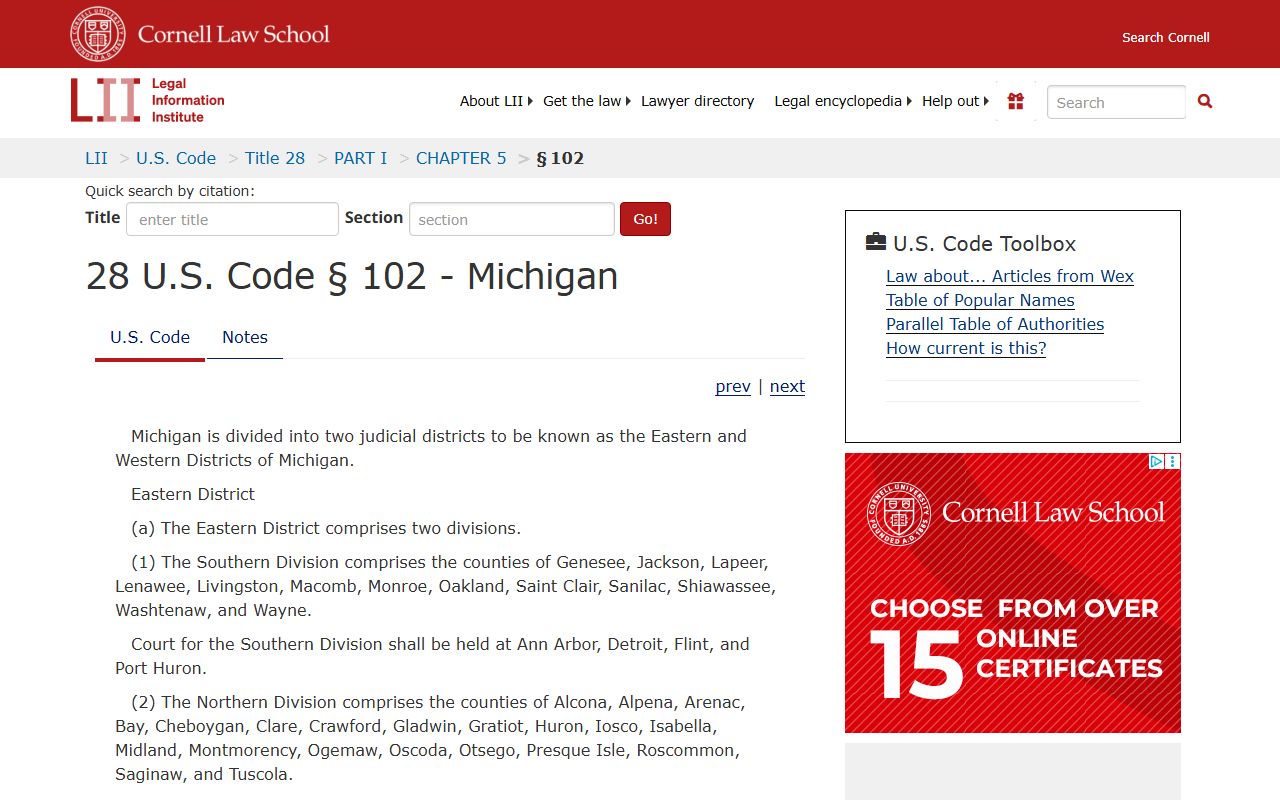
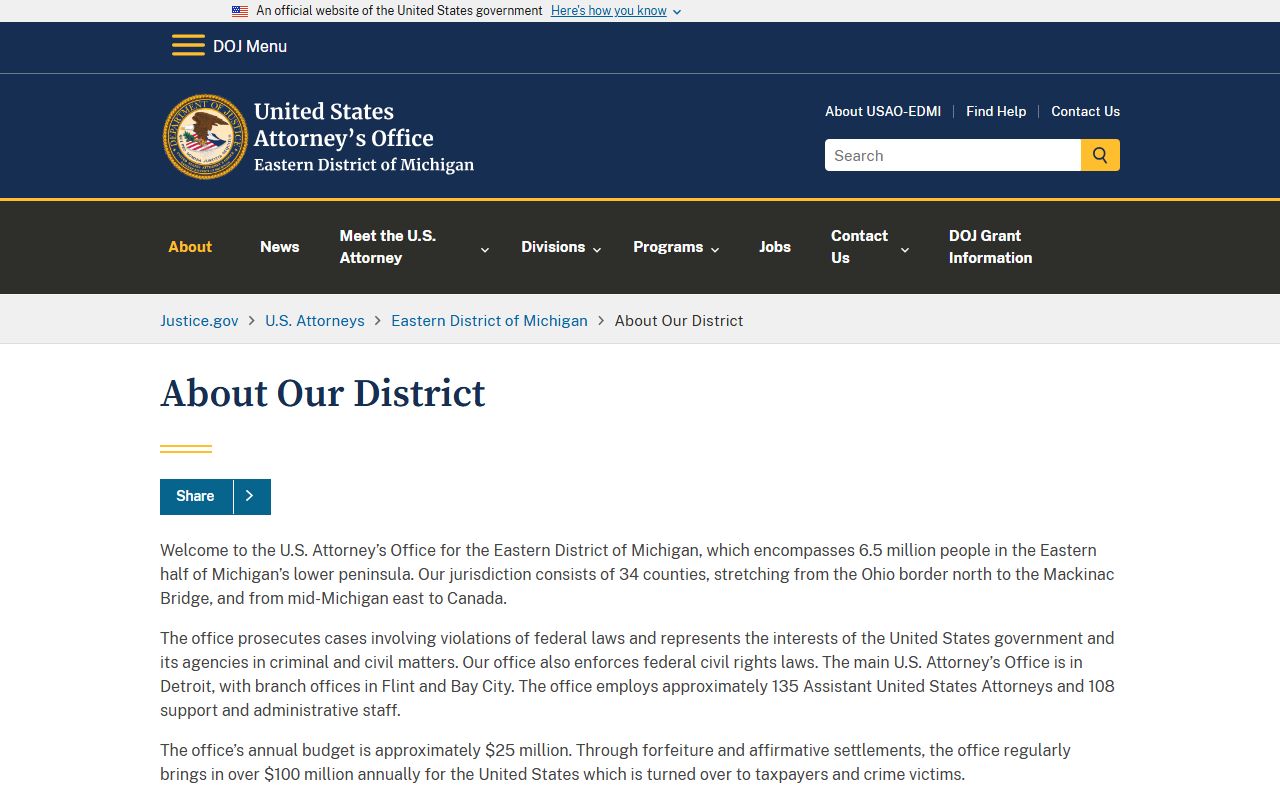
Federal prosecutions for the region run through the U.S. Attorney's Office, which covers 34 counties including Oscoda. The U.S. Attorney for the Eastern District of Michigan lists offices in Detroit, Flint, and Bay City.
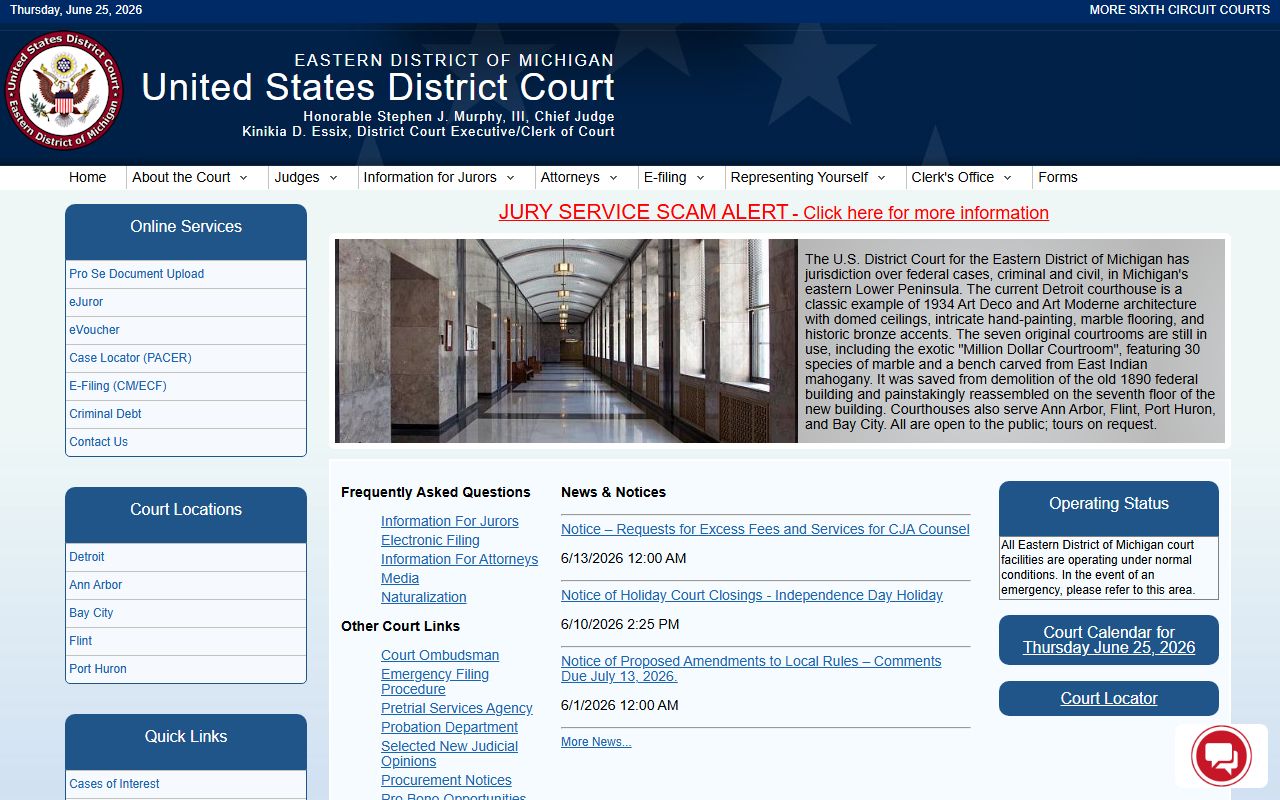
Case dockets, hearing schedules, and local rules for the trial court are posted online too. The Eastern District of Michigan court site links case access, e-filing, and courthouse locations.
Actual federal filings and documents are paid records held in one national system. The PACER service is where federal dockets and documents are searched and purchased.
Bankruptcy is handled separately by the district's bankruptcy court, and federal appeals from Michigan go to the Sixth Circuit, so a federal Oscoda County matter can span several court systems.
How to Read Oscoda County Court Records
Court files use shorthand that hides plain meaning. A charge is only an accusation, while a conviction is a proven result, and the two should never be read as the same thing. A disposition is the current outcome of a case or a count. A case marked dismissed with prejudice is closed for good, but dismissed without prejudice can be refiled. Knowing a handful of core terms makes a docket far easier to follow.
- Plaintiff
- The party who starts a civil lawsuit.
- Defendant
- The party sued in a civil case or charged in a criminal case.
- Arraignment
- The first hearing where charges and rights are addressed and bond may be set.
- Bindover
- Transfer of a felony from district court to circuit court after probable cause is found.
- Disposition
- The result or current status of a case or charge.
- Register of actions
- The chronological list of every filing and event in a case.
History of Oscoda County Courts
Oscoda County was established on March 10, 1881, carved from land once attached to Alcona County. The 1881 act named Union Corners as a temporary county seat and called for an election to fix a permanent one. After several attempts, Mio won out for its central location. The debate over moving the seat faded once the county built its courthouse.
That first courthouse went up in 1888 at a total cost of $3,754, woodshed and out-houses included. Court work in the county now runs through the 23rd Judicial Circuit and the 81st District Court, a regional structure that fits rural northern Michigan's geography and caseload. The county's history page holds the fuller story, including how Mio took its name.
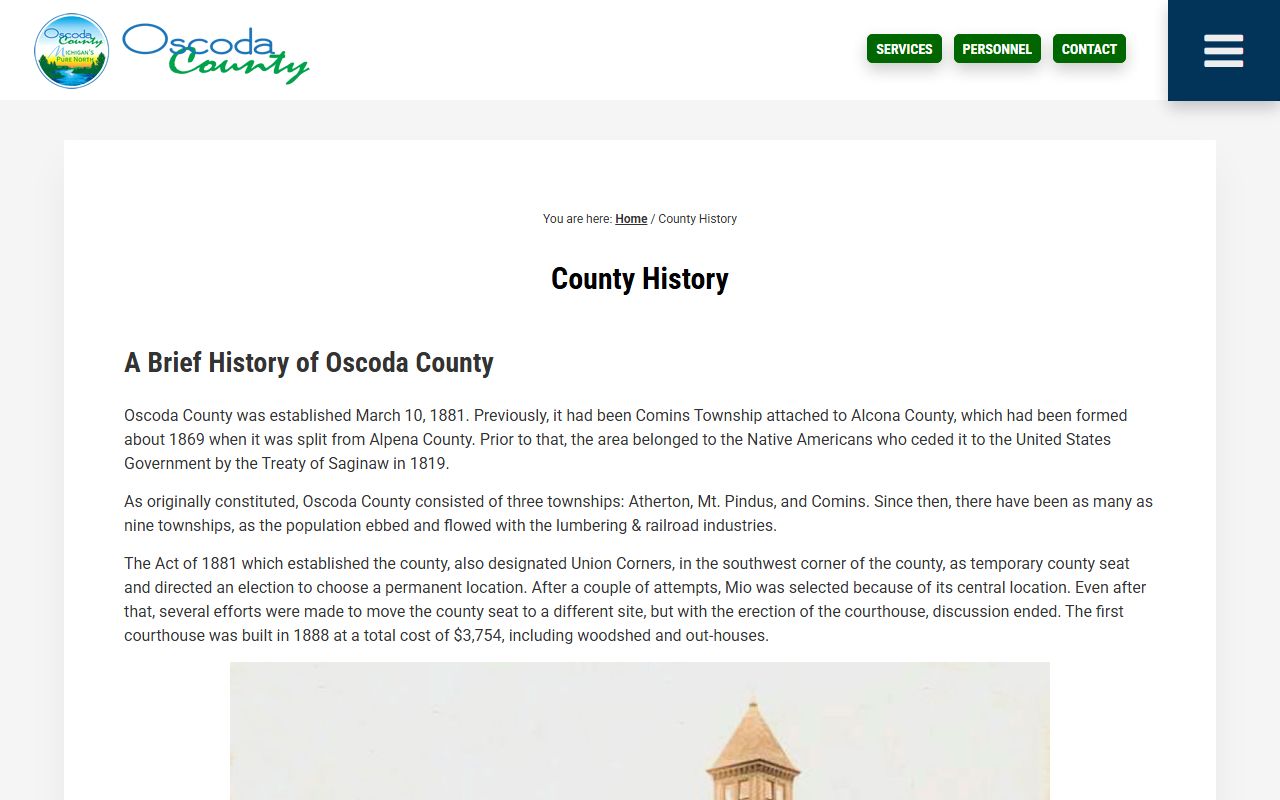
The same page notes that today's court offices sit on Court Street rather than in the original 1888 building, so historical color and current filing addresses are not one and the same.
Frequently Asked Questions
How do I search Oscoda County court records online?
Start with MiCOURT Case Search from the Michigan Courts and pick the right court, whether circuit, district, or probate. Search by party name or case number. The online view is limited to case number, party names, and case history, so the full file may need a counter visit or a NextRequest order. The Circuit Court display shows the day's hearings with party name, time, case number, and CTN.
Are Oscoda County court records public?
Most trial-court records are open, but the judiciary is not covered by Michigan's Freedom of Information Act. Court files follow court rules and local court procedure instead. Certain records stay restricted, including juvenile, adoption, mental-health, and sealed or set-aside matters. A public case entry does not guarantee every document inside the file is available for viewing or copying.
How much does a certified copy cost?
A certified copy of a conviction, judgment, or filed document costs $10 plus $1 per page. Noncertified copies, court forms, and the register of actions run $1 per page. A record search that requires staff to compile a new written record is $10. The court does not accept personal checks, though cash, money orders, certified checks, and AllPaid card payments are accepted.
Where is the Oscoda County courthouse?
The circuit court, district court, and central filing office share 105 S. Court Street in Mio. The County Clerk / Register of Deeds sits nearby at 311 S. Morenci Ave, and the Sheriff's Office is at 301 S. Morenci Ave. Court offices keep Monday through Friday hours of 8:30 a.m. to 4:30 p.m. Screening applies at the courthouse door, and weapons are barred.
How do I find out if someone is in the Oscoda County jail?
Oscoda County does not run a public online jail roster. To confirm custody, call the Sheriff's Office at 989-826-3214, or check Michigan VINE for custody status and to sign up for notifications. State prison, parole, and probation status is tracked in a separate state system, not the county jail records, so match the tool to the type of custody you are checking.
Can I get a court record removed from public view?
Michigan allows eligible convictions to be set aside under its Clean Slate laws, which make a qualifying record nonpublic for most background and public-search purposes. Courts, law enforcement, and some authorized agencies still keep access. A set-aside does not destroy the record. The process runs through the convicting court and requires state forms, background checks, and prosecutor notice before a judge can grant it.
What is the difference between a charge and a conviction?
A charge is an accusation filed by the prosecutor, and it can be amended, reduced, dismissed, or dropped as a case moves along. A conviction is a proven outcome after a plea or a verdict. Reading a charge as a conviction is a common and serious mistake. The full case file and its final disposition show whether a charge ever became a conviction.